
When people hear that I am a trauma surgeon, they often pause. When they learn I am Chair of the Department of Surgery, the pause grows longer. And when they realize I am also an Orthodox Jewish wife and mother, the questions begin.
They ask how I “balance it all.” They ask about wellness, physical and emotional. They ask how I integrate life as a surgeon and a mother, as if there is a formula, as if it ever gets easy.
But this path was never foreign to me. I grew up picturing myself in scrubs. My mother was a nurse, and I admired her strength, calm, and dignity. People told me nursing would be more “fitting.” But I knew I was being measured against a mold I never fit. Surgery drew me—the precision, the control, the immediate impact, the ability to turn chaos into order. In my mind there was never a contradiction between the discipline of the OR and the discipline of Torah life: both demand focus, humility, and exactness. That world made sense to me.
I was fortunate to grow up in a home steeped in mesorah and a clear sense of priorities. My father always said halakhah gives us a blueprint, not just to follow, but to build something meaningful within the boundaries of Torah. Ours was a home where questions were encouraged, curiosity was valued, and every answer was anchored in mesorah. My parents raised all of us to pursue our potential with integrity and purpose; my sisters are proof of that as much as I am. One is a physician assistant, the other a lawyer, each excelling in her own demanding field while staying grounded in the same values. Though schools in our world didn’t always agree you could be “non-cookie-cutter,” my parents quietly encouraged us to find our own place within the yeshiva framework. I chased what I loved wholeheartedly, never stepping outside the halakhic framework. I was told “you will never get married” more times than I can count, but I knew Hashem runs the world.
I always dreamed of being a doctor. I worked toward it for years, but when I applied to medical school the first time, I was rejected from every school. It was ablow. I questioned everything: my choices, intelligence, abilities, and path. Looking back, I see it was bashert (predestined). I ended up exactly where I was meant to be, at a school that shaped me in ways I could never have imagined. At the time it felt like failure; in hindsight, it was simply rerouting.
I could not have done this without my husband. From the very beginning, he believed in my dream even when others doubted it. His support wasn’t just in words. He made the daily sacrifices that let me train, take call, and build a career. He has been the one I cry to after the hardest days, the one who celebrates quiet wins that no one else sees, and who carries me through sleepless nights, the emotional toll of losses, and the thousand small moments where support matters most. He is koveia itim (sets aside time for Torah study), runs his own business, holds advanced degrees, and is proof that the values of the Orthodox world and intellectual accomplishment can thrive side by side. Just as behind every successful man there is a devoted woman, beside every successful woman there is an extraordinary man. Ḥazal tell us: ishto k’gufo—husband and wife are one. Marriage is the ultimate partnership, and everything I have accomplished has been because we are building together, with shared priorities and a shared mesorah. (We carry the Vizhnitz mesorah, our grandfathers from towns just miles apart in Eastern Europe. Each year we return to Bnei Brak for Rosh Hashanah, where the Rebbe once smiled and called me “the American trauma doctor.” It was with his blessing that I first set out on this path.)
Life as a Surgeon and a Mother
Trauma surgery is physically and emotionally demanding. I have worked more than 60 hours straight, operated while very pregnant, and stood for hours with a back that felt like it might break. There are nights when my pager goes off and within fifteen minutes I am standing in an OR, covered in someone else’s blood, making split-second decisions that will change the course of a life, my body aching from hours of holding retractors, tying knots, and standing without pause. I have gone from telling a family their loved one died to walking into the next room to save another, with no time to breathe. I have been paged in the middle of the night, and within minutes have been holding pressure on a wound while the team works to keep a patient from bleeding out.
As a frum Jew, I carry something else into the OR: a deep awareness that I am not in charge. While I scrub my hands before each operation, I daven. Every single time. I ask Hashem to guide my hands, to give clarity, to bring refuah (healing) if it is meant to be. Our work is romanticized, but the truth is, I am a glorified seamstress, a glorified carpenter. Hashem is the Rofeh (healer), and I am the shaliaḥ (messenger). My emunah carries me through both the successes and the failures.
Life outside the OR has its own challenges. I have faced hardships I could not control. I experienced a long and painful period of secondary infertility. As a surgeon, I was used to solving problems with skill, precision, and speed, but this was something I could not “fix.” Month after month, I learned to live with uncertainty and hope in the same breath. I have also faced losses I could never prepare for. When my mother died suddenly, it shook the foundation of my world. In the OR, I can anticipate, plan, and respond. In life, sometimes there is no warning, no intervention, no reversal. That loss deepened my compassion for the families I meet on the worst days of their lives, giving me a sharper awareness that every moment with those we love is a gift not to be assumed. These moments, and the challenges my husband and I have weathered together as a family, taught me a deeper
kind of patience and emunah, one that has served me in
every other part of my life.
Motherhood brings its own demands. There is never a “right time” to be pregnant in surgery. I have operated through exhaustion and nausea, broken scrub to throw up in the hallway, then rushed back to the patient whose life still lay in my hands, pumped in call rooms and closets. I missed more Shabbos meals than I can count during my training. Now I do not take call on Saturdays. That was a conscious choice my husband and I made together, so that our home and Shabbos remain an anchor, no matter what the week brings. I may not have been at every school performance during my training, but today I have more freedom, and like all working parents, I must choose. I hope I choose wisely, because quality matters more than quantity.
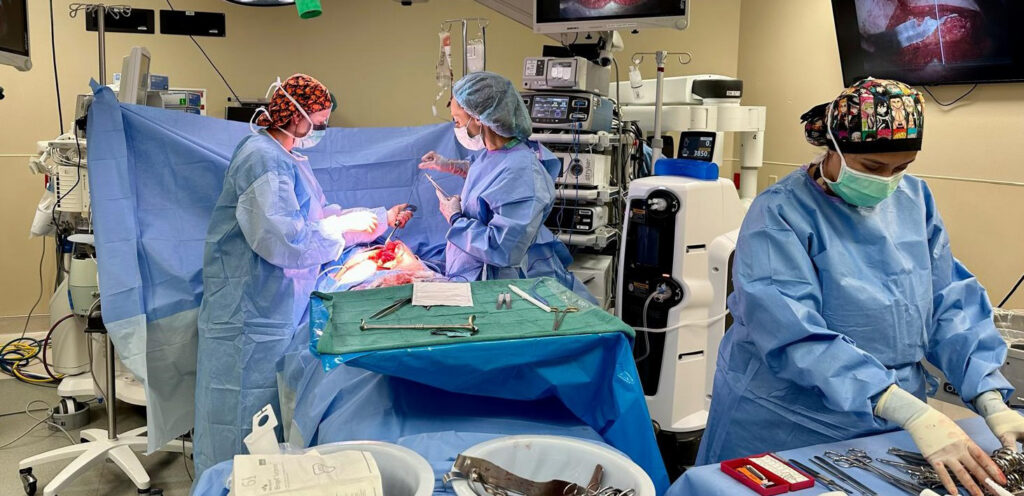
Dr. Kassai (in the middle) with surgical technician performing an emergency splenectomy
My days might begin operating on a patient with multiple gunshot wounds, continue in a departmental meeting, and end with a child melting down because I cut their sandwich the wrong way. The dissonance between sterile ORs and sticky kitchen floors has shaped me far more than any degree ever could. I make time for each of my children in ways that match who they are and what they love, whether that is watching a baseball game, learning Mesilas Yesharim, going for a run, baking cookies, or getting manicures. They have also become part of my professional world: coming to conferences with me, sitting in my office during meetings, and even observing me in the OR. My youngest has her own drawers in my office filled with toys and supplies so that she can settle in comfortably. These moments blur the lines between work and home in the best way, showing them that while my job is demanding, they are always welcome in it.
We live within the confines of our yeshiva world, and I am proud of that. I am a wife, a mother, and a community member. My profession does not define me. It is important work, and I do it with care and commitment, but it is work I value, not my essence. I make conscious choices every day, guided by emunah and halakhah. I show up for my children as I do for my patients: with clarity, consistency, and a full heart. The strength I draw on at work is the same strength I draw on at home. It comes from mesorah, Torah values, and from knowing exactly who I am. I hope my children grow to value conviction over convenience, meaning over noise, Torah over trend.
Nothing I do is about empowerment in the way it is often defined. It is not about proving that a woman can do whatever she wants. My life is not about equality or independence from the roles that Torah holds dear. My goal has always been to be the best daughter, wife, and mother I can be. Alongside that, I have been able to have a profession I love, one that lets me help people in moments of great need. But it is a piece of my life, not the point of my life. My anchor has never been the pursuit of self, but the pursuit of avodas Hashem (service of God) within the roles He has given me. My marriage, my children, and my family are the foundation. Everything else, even a career in surgery, is built on that. In the world I come from, we do not measure success by titles or podiums. We measure it by whether our lives reflect our values. By that measure, I am exactly where I want to be.
I often think of the pasuk in Iyov, adam l’amal yulad (man is born to labor), and of Ḥazal’s words in Pirkei Avos, l’fum tza’ara agra (according to pain is the reward). My work can be demanding, but the reward is commensurate with the effort. Long hours, emotional toll, and heavy decisions are the price of the privilege to do this work. I love what I do. Even when it is hard, even when it breaks my heart, I love it. For all the fatigue, there is meaning: There is the patient who recovers when no one expected it. The medical student who learns she can succeed in medicine and stay true to halakhah. The child who says, “Mommy, you fix people. That is why you work.”
I do not think of myself as a trailblazer. I think of myself as someone trying to do what is right. You do not have to reject Torah to function in the modern world. You do not have to give up tzniyus (modesty) to lead. You do not have to call it empowerment to be strong. There are sacrifices, and there is strain. But there is also purpose, mission, and brakhah. I carry with me my mother’s strength and optimism, the values my parents instilled, and the deep belief that our lives are defined not by what we achieve, but by how we serve.
Everything else flows from that. I am a Jewish mother. I am a surgeon. In that order.