

The first day of anything is really hard. Meeting new people, making a good first impression, finding your way around a new space. These are all part of the universal experience of a first day. Now, imagine that when you introduce yourself to your new boss, coworker, teammate, roommate, or acquaintance, you are confronted with the decision of whether to disclose a personal medical condition. You may feel uncomfortable sharing something so deeply personal with a stranger, but because the condition will eventually—and maybe even imminently—become obvious, hiding it (only to have it present itself later) may cause even more discomfort. This is my experience, and that of thousands like me, with Tourette Syndrome and other tic disorders.
You’ve probably heard about Tourette Syndrome from a movie or social media, but chances are you haven’t seen an accurate depiction of the disorder. Tourette Syndrome is a type of tic disorder. Tics are defined as involuntary, sudden, rapid repetitive movements or sounds. Examples of
tics include throat clearing, whistling, clicking sounds, head jerking, eye rolling, and facial grimaces. Tics are extremely common: 1 in 50 schoolage children in the United States has a persistent tic disorder, and 1 in 160 has Tourette Syndrome.1 It is estimated that 50 percent of cases go undiagnosed. Many people with Tourette Syndrome have very mild tics that are hardly noticeable to other people, and in many cases tics lessen in severity or even disappear in adulthood. However, some people’s tics are more severe and include cursing tics (called “coprolalia”). Although these cursing tics are quite rare, affecting only 1 in 10 individuals with Tourette, because they are easy to sensationalize, they are often used to portray the condition in the media.
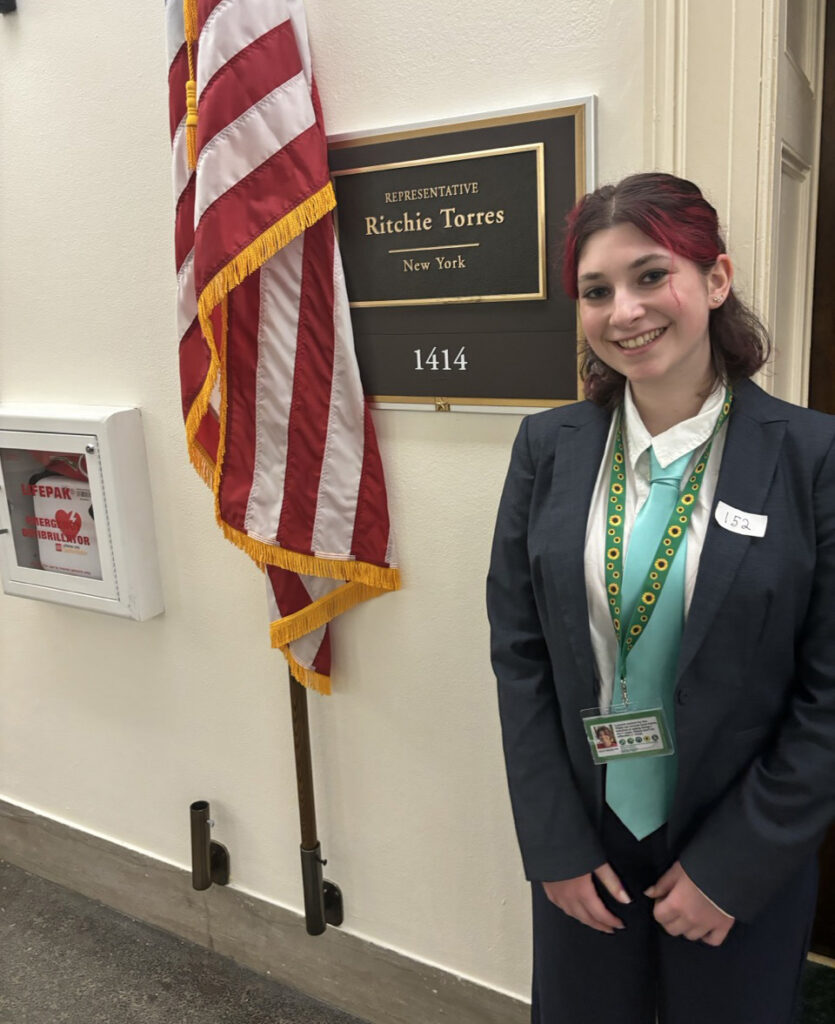
Lilly Halperin outside office of Congressman Ritchie Torres on Tourette Association National Advocacy Day
When tics are severe, it can be challenging and often scary to navigate public spaces, especially in quiet environments such as libraries or theaters. Certain tics— especially verbal tics and certain large movements— can lead to confrontations with strangers. These confrontations can be uncomfortable, and at times even unsafe. Imagine being on a crowded New York City subway, or being stopped by the police, and being unable to control your arm movements or the words coming out of your mouth! While these tics are often used as a cheap punchline on TV, there is nothing funny about living with them.
You may be wondering what causes Tourrette Syndrome, and why people with tics or Tourrette can’t control their sounds or movements. While the exact cause of Tourette Syndrome is unknown, research points to abnormalities in the functioning of certain structures and communication signals in the brain. In lay terms, the brain of someone with a tic disorder or Tourette sends out signals to make sounds or movements that the brain is not capable of appropriately filtering out. As a result, the person cannot control the sounds or movements.
Some people with the disorder have described tics as feeling like a sneeze you can’t stop or an itch you need to scratch, but my favorite analogy is the need to blink after prolonged staring. To get a glimpse of what Tourette Syndrome can feel like, try staring for as long as you can without blinking. At first you may feel some discomfort, followed by stinging, eyes watering, and blurring vision. Eventually the urge becomes too overwhelming, and you just have to blink. Once you blink you feel some relief, but you’ll probably need to blink multiple times to fully resolve the discomfort. Similarly, tics can be suppressed for short periods of time, but it eventually becomes painful and exhausting to suppress them. After suppressing a tic, it often comes out stronger or repeats itself in order to be resolved.
Tourrette Syndrome has many “co-occurring conditions,” meaning conditions that are frequently associated with Tourette. These include anxiety, OCD, depression, ADHD, behavior issues, difficulty with social skills and relationships, sleeping problems, rage, mood issues, and learning disabilities. According to estimates, 83 percent of people with Tourette Syndrome have at least one co-occurring condition. These conditions add extra challenges to managing tics. Because tics are often exacerbated with stress, when a person also lives with a co-occurring mental health condition, their tics can become worse when their co-occurring condition is not well-managed. Tourette Syndrome is often managed by deploying multiple strategies that can include medication, behavioral therapies that address tics, and managing cooccurring conditions.
My Journey with Tourette
For me, tics began when I was just seven years old. At the time, I didn’t have the language for what was happening to me. My early tics were quite bothersome to me and others; they included near-constant throat clearing noises, hand movements that involved pressing my fists into my stomach (imagine giving yourself the Heimlich maneuver!), and other uncontrollable sounds and movements. But after six months the tics faded, so I stopped thinking about them. For several years, my tics remained quite mild and didn’t interfere with my life. Then, suddenly, in November of ninth grade, my tics came back in full force. Once again, I was making all sorts of sounds and movements that I couldn’t control. It was then that I was seen by a pediatric neurologist who diagnosed me with a tic disorder and, subsequently, Tourette Syndrome.
In the months that followed, my tics became more noticeable, and people began asking questions. At the time, I was only three months into high school. I had finally begun to make friends in my new school, and suddenly I had this “othering” thing about me. I was scared. I spent a long time trying, unsuccessfully, to suppress my tics and hide them from others. Eventually, when my friends started asking about a sound I made or why I shook my head to the side, I fumbled through a quick explanation about tics, wishing I could make my tics—and even myself—disappear. I lacked the confidence and self-assurance to be comfortable in my body with tics. The year that followed was grueling.
Then, in the spring of tenth grade, my experience took a turn. Although I still had not found the right combination of medications and therapies to manage my tics, I found something even more important: my voice and my confidence. I found them by becoming a youth ambassador with the Tourette Association of America (TAA). Through the TAA’s Youth Ambassador program, I travelled to Washington, D.C. to participate in three
days of training and advocacy. The experience was transformational.
On the first day of the training program, I walked into a large conference room where I was one of hundreds of kids in the room who all had Tourette Syndrome. For the first time, no one was staring. I was not the only one ticcing. In fact, no one even noticed! I spent the next day learning how to speak about Tourette and to advocate for myself. I learned more about my condition and started to better understand my own brain. I made so many new friends, and I didn’t need to explain my tics to any of them. I finally found people who understood my life.
The Youth Ambassador training culminated with National Advocacy Day on Capitol Hill. There, I used all of the skills I had learned in the previous days to meet and speak with my congressional and senate representatives to advocate for legislation to address Tourette Syndrome. Our advocacy priorities included expanding telehealth, continued funding for Tourette research and public education programs, and supporting the Safe Step Act to improve access to essential medications and therapies. Since that first spring, I have attended three advocacy days on Capitol Hill, have led meetings with numerous government representatives, and this past year I had the opportunity to help train a new class of youth ambassadors.
Since training as a Tourette Association Youth Ambassador, I have seen the multi-fold benefits that can come from spreading awareness about our disabilities and differences. My initial motivation to share my experience of living with Tourette Syndrome—through advocacy, speaking engagements within my community, and speaking on education panels—was to spread greater awareness and understanding among my audiences. But through these speaking engagements, I also found a way to make “first days” and first meetings more comfortable for myself and those I meet. I’ve learned to introduce myself with a brief explanation of Tourette and an opportunity for the person I’m meeting to ask questions. I have become sufficiently comfortable in my disability to be forward and not feel the need to hide. And yet, there are still moments and spaces where I don’t feel at ease.
If an adult or child of a reasonable age is making noise that seems out of context or moving in a distracting way, they likely are not doing so voluntarily.
The Responsibility of Our Community
Sadly, among those spaces are Jewish communal spaces. Beit Knesset (synagogue) has been a particular challenge, due to my worry of disrupting others. I always make sure I am near a door so I can leave easily; but it can be a very stressful experience. As a community, we have a responsibility to make all community members feel welcome at home and in our batei knesset. Fulfilling prayer experiences should be accessible to anyone who wishes to engage. How can we create this change?
It is important to remember that if an adult or child of a reasonable age is making noise that seems out of context or moving in a distracting way, they likely are not doing so voluntarily. People like myself (and those with other disabilities) should be given grace in these moments and met with the benefit of the doubt. As a community, we can do our best to combat “shushing culture” in situations where someone is ticcing or otherwise unable to control their vocalizations or movements. We can make people with Tourette Syndrome (and other disabilities) feel welcomed and wanted by having patience in these situations.
Each person with Tourette is different and may have different preferences of how others should interact with their tics. While many times it may be okay to respectfully ask if they are okay, you can also ask a clergy member or community leader about this person if you are concerned. This way, they can have a private conversation about their needs and ways to approach this in quiet spaces. What is most important in these situations is to respect and preserve the dignity, humanity, and privacy of the congregant, and to remember that there is not a one-sizefits-all solution to help disabled community members. We need to put in the work to make people with Tourette Syndrome feel at ease, so that they don’t need to constantly suppress their tics for other people’s comfort.
Now that you have learned about Tourette Syndrome, you can make change. You can be mindful of people around you with Tourette Syndrome and other disabilities or neurodivergence. You can encourage others to be openminded and inclusive. You can educate others when they make a joke out of Tourette Syndrome or make ignorant remarks. You can use your knowledge to do your part in making the world more accessible, and in that way do your part in tikun olam (repairing the world).