
Every day, between 15 and 17 Americans die waiting for an organ transplant. Many could have lived had a posthumous donor been available. For Jews, with our deep commitment to pikuaḥ nefesh, the preservation of life, the urgency is self-evident. Yet organ donation also forces us to face one of modern halakhah’s most complex questions: how do we define the moment of death?
Halakhically, saving a life is among the greatest mitzvot. If a person is truly dead, donating their organs constitutes a supreme act of ḥesed. But if they are still alive, any act that hastens death is forbidden. Thus, the question is not whether organ donation is valuable, but how to define death in a medically reliable and halakhically valid way.
For centuries, death was determined by cessation of heartbeat and breathing—two functions that naturally stopped together. Modern technology has changed that. Ventilators can maintain respiration and circulation in patients who can never again breathe on their own or respond to their environment. This prompted halakhic authorities to ask: if a person can never breathe independently again and will never awaken, are they dead? The state is known colloquially as “brain death,” but halakhically, many prefer the term “respiratory braindeath,” emphasizing that the decisive factor is irreversible loss of respiration. This occurs when the brain stem— the control center for breathing—has been permanently destroyed.
The Israeli Chief Rabbinate accepted this criterion and, in consultation with medical experts, established strict protocols to determine respiratory brain-death which require:
1. Adequate waiting period after the catastrophic event to confirm the cause and irreversibility of brain damage.
2. Comprehensive bedside exam by trained physicians confirming total unresponsiveness and absence of brain-stem reflexes. (Patients in a vegetative state, by contrast, retain some reflexes.)
3. Apnea test verifying absence of spontaneous respiration.
4. Imaging study demonstrating lack of cerebral blood flow, confirming irreversible brain-stem destruction.
Once these steps confirm respiratory brain-death, the patient is declared halakhically dead. Although a ventilator may still circulate oxygenated blood for a limited time, organ retrieval may now proceed—allowing the deceased to grant life to others.The basis for this ruling is that the Torah links life to breathing: “And He breathed into his nostrils the breath of life” (Bereishit 2:7), indicating that spontaneous respiration is essential to being alive. The Talmud (Yoma 85a) describes testing for breath near the nostrils to determine death, again identifying respiration as the vital sign. Still, not all halakhic decisors accept the respiratory brain-death standard. They argue the Talmudic test applies only when no other life signs exist—if the heart continues to beat, even through artificial means, the patient is not yet halakhically dead. Even if they are “brain-dead,” their heartbeat can be kept going for a few hours or days (and occasionally weeks) until that too will stop alongside other organ functioning. Since organs will usually lose their vitality by this point, this position greatly limits opportunities for life-saving donation.
Contemporary Rabbinic Views
In Israel, the religious Zionist community, following the rulings of the Israeli Chief Rabbinate, are unanimously supportive of respiratory brain-death criteria. These poskim include Rabbi Yosef Zvi Rimon, Rabbi Yaakov Ariel, Rabbi Shlomo Aviner, and others from the full spectrum of the religious Zionist community. In fact, it’s hard to identify another controversial halakhic topic in which there is such universal support within this community. Prominent Sephardic authorities—Rabbi Mordechai Eliyahu, Rabbi Shlomo Amar, Rabbi Eliyahu Bakshi-Doron, and Rabbi Ovadiah Yosef—also support this standard. During the Iron Swords War, 13 soldiers were declared dead under these criteria and donated organs that saved 58 lives!
Ashkenazic ḥaredi authorities, however, including Rabbi Eliezer Waldenburg and Rabbi Yosef Shalom Elyashiv, reject respiratory brain-death as halakhic death. Consequently, their followers generally refrain from posthumous donation. In North America, debate, sometimes vociferous, has centered on disputes regarding positions attributed to Rabbi Moshe Feinstein and Rabbi Joseph Soloveitchik, generating decades of controversy.Several centralized rabbinical institutions—such as the Sydney Beit Din (led by senior Chabad rabbis), the Johannesburg Beit Din, and the Office of the Chief Rabbi of the British Commonwealth—give support to families who wish to donate, while affirming that Jews may also decline for legitimate religious or emotional reasons.
Ematai’s Approach: Liberty, Sensitivity, and Choice
Ematai, continuing the work of the Halachic Organ Donor Society, promotes religious liberty, informed choice, and compassionate support for all Jews facing this decision.
1. Religious liberty: Countries should respect the full range of opinions regarding the neurological criteria of death and recognize that some religious traditions and ethical perspectives will not permit organ retrieval after respiratory brain-death has been determined.
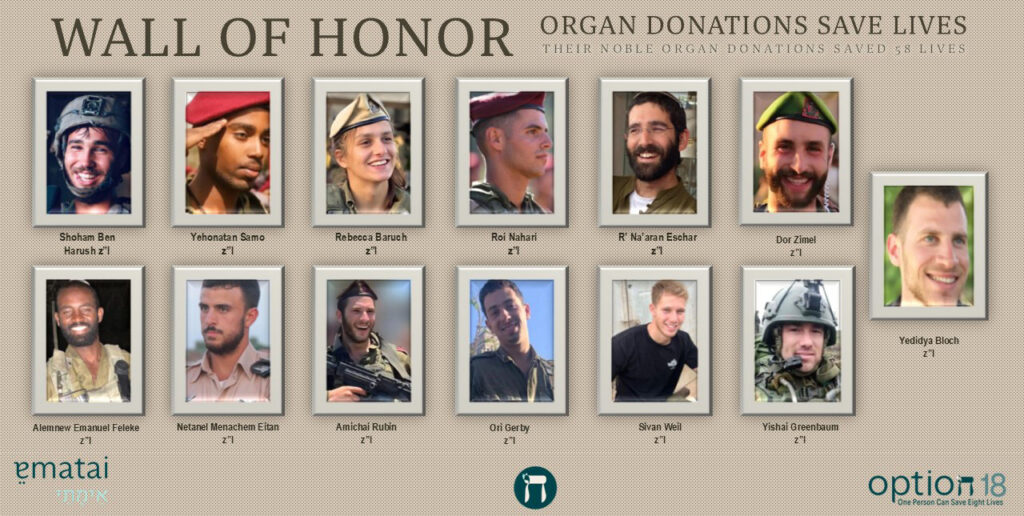
Posthumous organ donations by these IDF soldiers saved 58 lives.
2. Cultural sensitivity: Health organizations should undertake initiatives to educate about organ donation and provide transparency regarding the organ retrieval process. Ematai works with many organ procurement organizations around the world to ensure cultural sensitivity regarding Jewish perspectives on death and organ donation.
3. Emotional support: Jews who have lost their loved ones, frequently suddenly and unexpectedly, should be embraced by the community and provided with full emotional support regarding any decisions made on organ donation.
4. Informed Choice: Jews may choose to donate organs in consonance with their views regarding respiratory brain-death. From our 20 years of experience, we have found that many Jews (or their proxies and families), in consultation with their rabbis and healthcare providers, choose to donate for one or more of the following reasons:
• They accept the respiratory brain-death criteria found throughout the world.
• They believe that if they would be in need of a lifesaving organ, they would hope someone would donate to them. Now that they have the opportunity to donate and save lives, they wish to help prevent the unnecessary deaths of fellow members of society, in the spirit of beneficence, solidarity, and reciprocity.
• They find comfort knowing life emerged from their tragedy.
• They view organ donation as a final mitzvah and merit (zeḥut) for the deceased.
However, some Jews, like other members of society, elect not to donate, for a variety of emotional, religious, and cultural reasons. Their wishes must be respectfully accommodated. I myself am a registered organ donor, but always honestly and fairly teach both sides of the debate. Our community only gains from open discussion and proper education about this sensitive topic.
Determining Respiratory Brain-Death in Practice
The Israeli statutory requirements are very strict and extremely reliable. Similar criteria are used in North America, though specific protocols may vary by state and hospital. Major hospitals routinely perform these tests, and families may request that all steps be completed. ‘Brain-death’ declarations are not made quickly, leaving time for halakhic consultation, which is strongly encouraged before death is declared. Ematai’s Robert M. Beren Medical Halacha Helpline operates 24/7 to assist families and rabbis during these critical moments. The goal is to empower those who wish to donate to do so with full halakhic and emotional assurance.
Distinguishing DBD from DCD
Recent headlines have blurred distinctions between different donation practices. It is essential to distinguish Donation after Brain Death (DBD) from Donation after Circulatory Death (DCD). • DBD applies when respiratory brain-death has been conclusively established; organs are removed only after death is declared. • DCD, by contrast, involves patients who are still alive by all standards but whose families and doctors decide to withdraw life support due to a hopeless prognosis. After the ventilator is removed, the heart stops, death is declared on circulatory grounds, and organs are quickly retrieved. According to nearly all Orthodox authorities, DCD is not permissible. Actively withdrawing life support to hasten death violates halakhic prohibitions. Israel therefore prohibits DCD. Recent U.S. controversies involving DCD protocols should not be confused with organ donation after confirmed respiratory brain-death, which operates under entirely different ethical and halakhic premises.
Becoming a Halakhic Organ Donor
Those who accept respiratory brain-death criteria can technically register in two primary ways:
1. National registries: In the U.S., one can register with Donate Life America or through the Department of Motor Vehicles. These are legally binding directives authorizing organ retrieval once death is declared under state law in accordance with the hospital’s protocols. While families may request consultation with their rabbi in these cases, the organ procurement organization is under no legal obligation to allow for halakhic review.
2. Halakhic Advance Directive: Alternatively, one can sign a directive authorizing donation only after halakhic confirmation by a designated rabbi or proxy. Ematai’s directive, available at ematai.org/netivot, offers precisely this model.
Most importantly, individuals should discuss their preferences with family and rabbinic advisors. Respiratory brain-death cases are rare, but when they occur, a single donor can save multiple lives. Ematai’s Option 18 initiative underscores this: 18 symbolizes ḥai—life—and reflects the potential for one person to donate up to eight vital organs.
By promoting education, transparency, and halakhic rigor, the Jewish community can engage modern medicine responsibly. Organ donation, when performed within halakhic bounds, represents one of the greatest expressions of faith in life’s sanctity and human responsibility. For further guidance and resources, visit option18.org.