
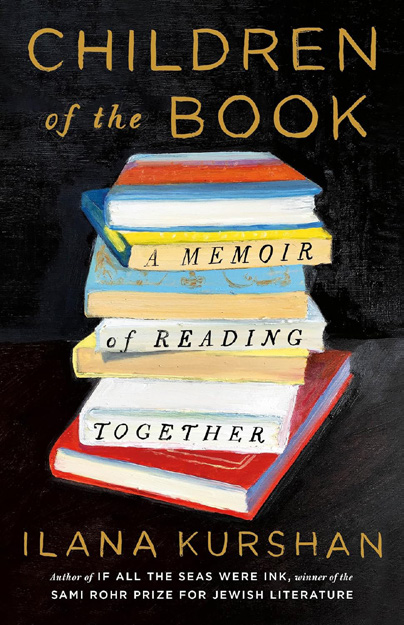
In her award-winning first book, If All the Seas Were Ink, Ilana Kurshan uses the structure of the Talmud daf yomi cycle as a lens through which she reflects on her life as it develops over the seven-year period of that cycle. In her current book, Kurshan follows a similar structure, this time built around the annual cycle of Torah reading, which she uses as a lens to reflect on her family life and her children’s engagement with books. The nature of the project is indicated by the title of the book: The “Children of the Book” are both the Israelites of the Torah and Kurshan’s own children. The “Book” is both the Torah and the various books read to or by those children. Throughout the book, Kurshan draws parallels between her family’s life and either the incidents in the Torah or the books her children are reading.
The book is divided into five main sections, one for each of the five books of Ḥumash. Each section contains essays in which Kurshan reflects on the books read to or by her children at the various stages of their development that parallel the biblical narrative. Bereishit tells the story of the creation of the world out of chaos and the earliest beginnings of the Jewish people. In this section Kurshan describes the earliest reading experiences of her children—from board books to picture books.
Shemot tells the story of the Israelites gaining independence. The essays in this section deal with Kurshan’s children’s growing independence—both in developing their individual personalities and in starting to read on their own. Several of the essays deal with her ten-year-old twin daughters as they develop their own identities, with different friends and different books.
Vayikra is primarily about the Mishkan (Tabernacle) and sacred space. Kurshan sees the Mishkan as a site of intimacy between God and Israel, and as a model of the intimacy she seeks to forge with her children through reading together. She also reflects on the library as a kind of sacred space that requires decorum and respect, and that teaches her children how to behave in shul. Bamidbar tells the story of the Israelites wandering in the wilderness, filled with doubt and uncertainty about the future. In this section Kurshan describes her family’s life during the Covid lockdown, when there was a similar feeling of not knowing when or how it would end.
In Devarim, Moshe narrates his version of the Israelites’ journey out of Egypt and through the wilderness, which often differs from the version in the previous books. Kurshan sees this as a kind of memoir. In this section she reflects on novels by authors writing about their own lives, such as the Little House books by Laura Ingalls Wilder. She compares the novels to the more factual account in Wilder’s memoir in order to teach her children that people can be selective about which parts of their story they choose to share. Devarim ends with Moshe’s death, leaving the Israelites to go on without him, which leads Kurshan to reflect on the need to learn to let go as her children grow up.
Kurshan notes that each time she reads a Torah portion, she has different insights depending on events in her life at the time. Sometimes those insights come from the actions of her children. For example, in an essay entitled “The Unreliable Narrator,” Kurshan describes an incident that occurred when her children returned to school during the Covid lockdown. One of their friends reported overhearing that there had been thieves in the school, trying to steal the computers. The report turned out to be false, but Kurshan’s children readily believed it and exaggerated the details in their retelling of the story. Kurshan understood this as an outgrowth of their general sense of fear and danger resulting from Covid, which led her to speculate that a similar sense of fear of the unknown may have led the meraglim (spies) to exaggerate the dangers of the Land.
This book is a pleasure to read. The writing is flowing, often poetic, and the parallels Kurshan draws are often insightful. I felt a twinge of recognition in reading her descriptions of books she had read with her children, many of which were my favorites from my own childhood or from reading to my daughter or grandchildren. She also referred to a number of books that were unfamiliar to me and that I now want to check out.
The end of the book contains a list of some of the books described in the body of the text, divided into picture books, series for early readers, and chapter books. I wish that the list included all the books she discussed, perhaps with page references.
I highly recommend this book, which artfully weaves together Torah, secular books, and parenting into a rich tapestry.