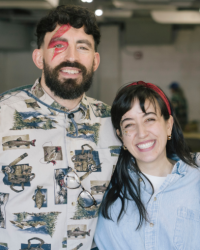
Benjamin’s Story: “When my teachers asked in Hebrew school what I planned to be when I grew up, I never imagined I’d be struggling with a heroin addiction, stealing from my parents’ peace of mind and pocketbooks, or trading a bunk bed at Camp Young Judea for a bunk bed in a jail cell. I had everything I needed to succeed. I had loving parents, good friends, knowledge of right from wrong. Still, there was a void inside me that nothing could fill, a darkness that consumed me despite all the love surrounding me. Alcohol and drugs became my solution, settling me down in a way I’d never experienced before, giving me the oblivion I craved, until I found heroin and my life spiraled into a nightmare I couldn’t escape for almost a decade. The trajectory of my life was heading straight to a long-term prison sentence or a box in the ground.”
When I met Benjamin and he shared this story with me, I realized that my family, and so many others, were not alone.
The Crisis: Addiction and Disconnection
Today, over 46.3 million people in the United States live with a substance use disorder. In the past year alone, more than 103,000 people have died from drug overdoses. This is a staggering number that represents both a national and a deeply personal tragedy. Despite ignorance or denial, the Jewish community is not immune. A recent UJA-Federation study found that over 432,000 Jews in New York City currently struggle with addiction, and the numbers continue to rise. This is not an abstract crisis. It is in our families, our shuls, our schools, our Shabbat tables.
Addiction is not a failure of willpower or morality. It is a chronic condition that changes the brain’s reward and stress systems, often driven by trauma and isolation. It thrives where pain and disconnection meet. Addiction takes many forms—not only substances, but also behaviors, relationships, and even patterns of thought that become compulsive and self-defeating. There is no single universally agreed-upon “reason” for addiction. Doctors, scientists, psychologists, coaches, and researchers attribute it to some unclear combination of genetics, trauma, natural disposition, circumstances, and connection (or lack thereof) to community.
I believe that this is an obvious call to the spiritual. It’s a reminder that beyond medical explanations, we are dealing with the fundamental human need to connect, to belong, and to find meaning.
For too long, addiction has remained on the periphery of communal conversation, treated as something private, shameful, or beyond our capacity to respond to. Stigma remains one of the greatest barriers to healing. Too often, people in our own communities suffer in silence, afraid to speak their truth. But the truth is: Judaism offers a spiritual and communal infrastructure uniquely suited to healing the wounds of addiction.
Why Jewish Community Matters
Across the country, a $43 billion treatment industry offers time-limited detox programs. Yet 80 percent of those who complete treatment relapse. Because even when detox works, patients often return to the same isolation, pressure, and disconnection that fueled their addiction in the first place. Sustained recovery depends on more than medical intervention. It requires human connection. Research indicates that the number one predictor of sustained sobriety is consistent presence in community over time. Jewish community, with its rhythms of gathering, prayer, and shared responsibility, offers exactly the kind of structure and belonging that can sustain long-term healing.
In the book of Eikha, Jeremiah cries out with heartwrenching, haunting laments about the destruction of Jerusalem. He paints a picture of total devastation and isolation—where loss of home, community, and spiritual center leaves the people untethered:
To what can I liken you to console you, fair maiden Zion? Your breach is vast as the sea; who can heal you? (Eikha 2:13)
Rashi, commenting on this verse, notes that when people experience devastating loss and suffering, they instinctively seek comfort through connection: “When trouble befalls a person, [people] say to him, ‘This also happened to so and so,’ as a consolation for him.”
Sometimes, though, suffering can feel incomparable in scope and isolation, so overwhelming or isolating, that even shared experience cannot offer comfort. It is precisely at that point, when human solace reaches its limit, that the Sages of the Midrash offer a different vision. As if having sat with addiction themselves, they articulate the hope that we aim to animate and make real for people in addiction. They answer the question posed by this verse: The same God who once split the Sea will one day mend what feels beyond repair (Eikha Rabbah 2:17) In other words, the same divine force that brought order from chaos, that turned the waters of creation from paralysis into movement and from silence into song, can also mend what feels beyond repair.
Desolation is not the end, but is the place from which healing might begin. This is the essence of what recovery means: the vastness of the wound is not evidence of hopelessness, but of the scale of healing required and the urgency of reaching toward God and each other. The Rabbis teach that no pain is too deep for divine repair; the healing, like the Sea, must be immense.
This is also Benjamin’s story: “Community became my mirror, showing me what I couldn’t see, holding me up with love and compassion until I could stand on my own, teaching me to find my passion, discover my purpose, and live as my authentic self. I walked in as a shadow of a man, and now, just reaching nine years of sobriety, married to the love of my life with two children, working as a musician with my family back in my life, the greatest miracle isn’t any of that. It’s waking up every morning with a true sense of peace and love for myself—finally able to show up as me, for me, and for the ones I love.”
Selah: A Community for People in Recovery and Those Who Love Them
People have the innate capacity to heal in community. This conviction animates Selah, the community we are building in Brooklyn for people in recovery and their loved ones. We use the Jewish calendar as our scaffolding, moving through the seasons of joy, introspection, loss, and renewal to build an integrative spiritual life rooted in recovery and Jewish wisdom. Our communal values mirror both Jewish and recovery principles:
- Celebrating joy
- Sharing sorrow
- Practicing accountability
- Honoring the unique Torah of those in recovery
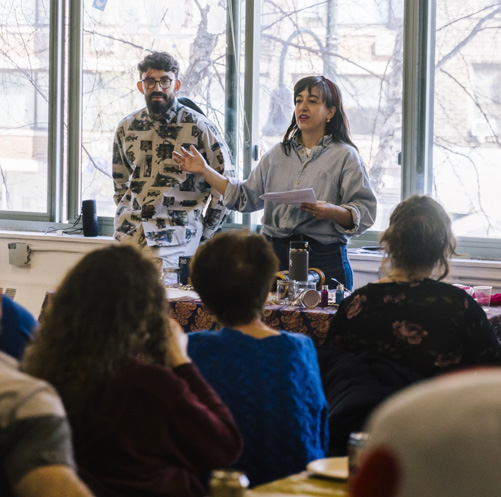
Selah is not a support group or a synagogue alone. It is a community that believes healing happens in relationships. We gather around Shabbat tables, in living rooms, in parks—in moments of celebration and grief alike. We’ve watched people who once felt defined by their pain begin to lead: to teach Torah, to hold space for others, to claim their place in Jewish life. There is something holy about that moment when someone realizes they don’t belong despite their story, but because of it. Interestingly, our very brokenness may be our greatest opportunity for connection.
Rosh Hashanah 5784, Brooklyn, NY
Lilah walks to the front of the warmly lit room, takes a deep breath, and turns to face the 120-person crowd in a Brooklyn basement on the second day of Rosh Hashanah. “Hi, my name is Lilah, and I am an alcoholic. The day I picked up alcohol, when I was 15, I also put down God. I’m here today despite finding a home neither in recovery spaces nor in Jewish spaces where I could fully be me. Here today, though, I am my whole self. Shanah tovah.” The crowd applauds, and as we begin our inaugural Rosh Hashanah second day experience, the leader sings the Serenity prayer, a familiar sound for many of our folks, to the tune of the traditional Rosh Hashanah opening liturgy.
This is a picture of our community: both for those whose entry point to Judaism is recovery, and for those whose entry point to recovery is Judaism. That’s what we’re doing here.
For many of us in recovery or who love someone in recovery, our religious lives and recovery identities have been bifurcated—left at the door when we walk toward a synagogue, or completely forgotten when entering a twelve-step meeting. What if our religious spaces were ones to which we brought our whole selves—ugly, broken, confused—and found refuge in the wisdom of our ancestors and support of our communities?
A Call to the Jewish Community
Addiction is not someone else’s problem. It is ours. It is also our opportunity to be the kind of community that does not look away, that meets despair with care, and that transforms ancient wisdom into modern healing. Recovery is not only about abstaining from what harms us, but about remembering what holds us. We have the tools to bring light into some of the darkest corners of suffering with the gifts of our ancestors and our inner divinity. For this to work, we cannot live in ignorance or denial.
May the One who healed the Sea heal us all, too.