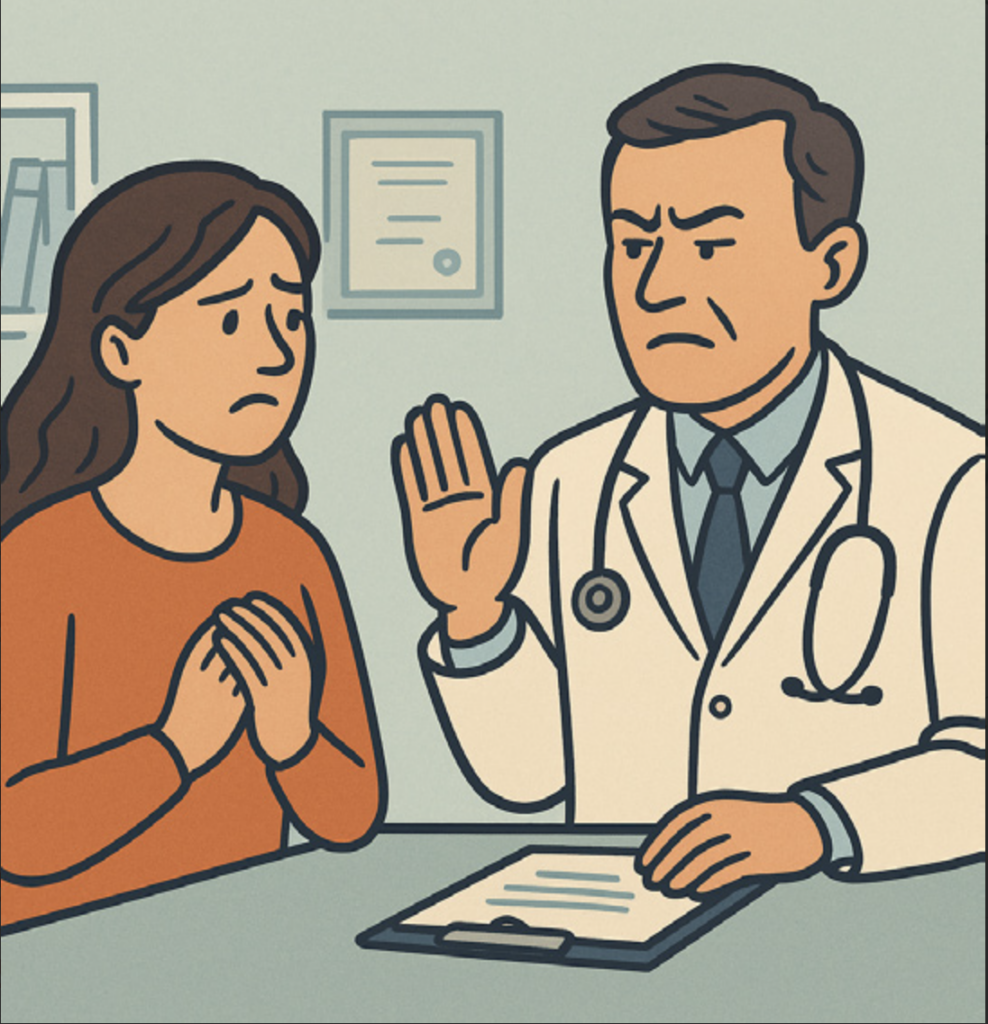
I was in my early twenties, already five years into an eating disorder that had consumed much of my young adulthood. My life had become unbearable: intrusive voices narrated my every meal, obsession circled around food and control, and small choices felt freighted with shame. Out of desperation, I finally sat in a doctor’s office and said the words aloud:“I have an eating disorder.” I thought naming it directly would open the door to help. Instead, he shook his head and replied,“No, you don’t. You just need to take better care of yourself.”
His words weren’t just dismissive—they were dangerous. In that moment, something far deeper than a medical opinion was taken from me—my dignity, what our tradition calls kavod habriyot, the sacred obligation to honor the worth of every human being. I knew what I was naming, not only because I had studied the diagnostic criteria as a psychology major, but because I was living it every day: consumed by voices, shame, and the relentless grip of control. Yet his refusal shut the door to treatment and delayed my getting real help for another two years. Those years were marked by spiraling illness, silence, and the feeling of being erased.
My story is only one thread in a vast tapestry. Every woman I know has some version of it. A friend with fibroids was told for years that her pain was “normal,” until the situation became so severe that she eventually required a hysterectomy. Another, living with endometriosis, was brushed off with “just bad cramps” while her pain grew unbearable. One woman went to the ER with chest pain and was told she was “anxious.” A new mother reported frightening postpartum symptoms and was told to “get more rest.” Each dismissal is not only a failure of medicine, but a violation of the Torah’s call to compassion, a moment where the command lo ta’amod al dam rei’ekha (do not stand idly by the blood of your neighbor) (Lev.19:16) was ignored.
These stories echo across generations. Our mothers and grandmothers remember being told to “tough it out,” to “calm down,” to accept pain as their lot. My own grandmother knew something was wrong with her unborn child, but her concerns were dismissed, and she suffered the unimaginable loss of a stillborn baby. The dismissal cut so deep that when she became pregnant again—with my mother—and felt the same warning signs, she feigned labor just to be admitted to the hospital. Her story is not unique; it belongs to a long lineage of women who had to outwit a system that refused to listen. The pattern is so common that researchers have a name for it: the pain gap.1Medical Discrimination Against Women
Medical Discrimination Against Women
Studies confirm what women’s stories have long revealed. Women wait longer than men to receive pain medication in emergency rooms and are more likely to be prescribed sedatives instead of analgesics.2 Women reporting cardiac symptoms are more likely to be sent home without testing.3 Black women face compounded disparities: they are far more likely to have their pain ignored, their symptoms misdiagnosed, their conditions untreated.4 Eating disorders illustrate the danger clearly. Women who disclose symptoms are often told it is “just stress,” “a phase,” or “vanity.” One study found that clinicians are significantly less likely to diagnose an eating disorder in a woman of color than in a white woman presenting with the exact same symptoms.5 The result: years of untreated illness. Eating disorders are not benign; they carry the second-highest mortality rate of all psychiatric conditions.6 Mental health struggles follow the same pattern. Women who report fatigue, anxiety, or somatic complaints are frequently told to rest, calm down, or manage stress, while serious conditions go untreated.
This dismissal is not coincidence—it is systemic. Medicine has long been shaped using male bodies as the “default.” Women’s bodies were considered variations on that norm, their pain dismissed as hysteria, their suffering pathologized as emotional rather than physical. Although much has changed, echoes of this history remain. For decades, the overwhelming majority of medical research focused on men’s bodies, and women were excluded from clinical trials because of the “complication” of menstrual cycles or the possibility of pregnancy.7 The result is that
our baseline knowledge of heart disease, drug efficacy, and disease progression has been built on male-centered data.
This gap has real consequences. Heart disease is the leading cause of death for women, yet the “classic” symptoms studied and taught in medical schools were modeled on men. Women’s symptoms often present differently—fatigue, nausea, shortness of breath—but were dismissed as anxiety or stress because they didn’t match the male template.8 Even today, medications are more likely to be tested on men, with dosing recommendations that fail to account for women’s physiology. Only in the 1990s did the National Institutes of Health mandate the inclusion of women in federally funded clinical research.9 We are only beginning to see studies that take women’s bodies seriously in cardiology, neurology, pain management, and mental health. The fact that it took so long reveals why women have had to advocate not only in the doctor’s office, but also in the very design of the systems meant to care for us. For many of us, this is not abstract history—it is the reality of living every day inside bodies dismissed by those who should have listened. To erase women’s bodies from research is to deny their tzelem Elokim—treating half of humanity as if it does not reflect the divine image.
Bias deepens the problem. Clinicians are more likely to perceive women as exaggerating symptoms.10 Cultural expectations add layers: women are told to be patient, modest, strong for others. In Jewish communities, conversations about bodies, sexuality, or mental health may be further silenced by modesty norms or stigma. The net effect is that women often walk into systems already primed to doubt them. When they speak—about pain, about fear, about their own bodies—the dismissal can be devastating. To refuse to hear their voices is not simply poor practice; it is a failure to live up to the God we call Shomea Tefillah, the One who hears prayer.
Listening is not a soft skill but a sacred mandate. Believing those who cry out in pain is an act of honoring tzelem Elokim. Acting on their words fulfills lo ta’amod al dam rei’ekha. Preserving their dignity restores kavod habriyot. When a woman’s voice is heard and her pain believed, Jewish values move from the page into the living world.
The Need for Self-advocacy
Self-advocacy, then, becomes not only an act of survival but a form of holy resistance. It is hard work to raise one’s voice in rooms designed to quiet it, yet it is also essential. It can begin with something as simple as writing down symptoms and questions before an appointment, creating a paper trail that cannot be waved away. Bringing a trusted support person into the room changes the power dynamic and reminds the clinician that you are not alone.
The questions themselves can open doors: What else could this be? What would you recommend if I were your sister or daughter? What are the risks if we wait? What tests can rule things out? What would it take for you to be concerned? Can you explain how you came to that conclusion? Each question insists on partnership rather than passivity.
Self-advocacy can also sound like slowing the room down: I need a moment to process what you’ve said. Can you go over that again in plain language? It can mean asking directly: What is the plan if this treatment doesn’t work? Can you document my concerns in my chart? It can look like requesting access to your medical notes, so your words are not lost in translation.
Sometimes it is not about questions but about naming the reality: I know my body, and something is wrong. I hear you, but I need you to take this seriously. I want this recorded as a formal symptom, not an aside. These statements resist dismissal, turning vague concerns into testimony.
Self-advocacy can also mean persistence over time: seeking second opinions, asking to be referred to a specialist, requesting copies of lab results rather than waiting passively for a call. It is exhausting work, but it saves lives.
Every time a woman insists on her own voice, she is not speaking in the abstract—she is speaking from the reality of living every day in her body, with knowledge born of survival. Each act of persistence affirms the image of God within her and demands that others see it too. To advocate for oneself in these ways is not only a practical necessity but a spiritual declaration: my body, my voice, my life matter.
The Role of Community
Communities have roles to play as well. Synagogues and schools can host health-education nights led by women professionals, recognizing such gatherings as modern expressions of bikur ḥolim, the mitzvah of caring for the sick. Rabbis and leaders can show in sermons and pastoral care that women’s voices matter, embodying the God who hears. Communities can create peer networks for women navigating chronic illness, mental health issues, or caregiving, so that no one faces silence alone. Systemically, representation is key: more women in medicine, research, and leadership shifts whose voices shape the system. Training clinicians about bias and tracking disparities creates accountability. These efforts, too, are Torah in action.
It is also vital to amplify the voices of the women already leading in this work. Too often, female physicians, researchers, and community leaders speaking about disparities in care are overlooked or spoken over. Elevating their work is part of our communal responsibility. Quoting their studies, inviting them onto panels, funding their projects, and sharing their writing ensures that women’s expertise shapes the design of medicine, research, and policy.
The cost of silence is measured in years of untreated illness, in lives lost, in communities weakened. When women are ignored, families suffer. Children grow up without mothers who could have been saved. Communities lose leaders, teachers, nurturers. The cost is spiritual as well. A community that ignores women’s voices betrays its own Torah. To live as if dignity does not matter is to hollow out our tradition’s core.
There is power in voice. I eventually found clinicians who listened. They heard my words, trusted my story, and gave me the care I needed. Their belief was not only the start of recovery—it was the restoration of my dignity. Advocacy is not easy. It demands courage, persistence, and community. Every time a woman insists on being heard, every time a community insists on listening, we chip away at the silence and invite holiness into the room.
Our foremothers knew this. The midwives Shifra and Puah defied Pharaoh by listening to the cries of Hebrew women in labor and preserving life. Hannah poured out her soul to God, insisting her silent suffering be recognized. They teach us that women’s voices have always been powerful, and that survival often depends on them. We inherit their courage. Now it is our turn to raise our voices—in the doctor’s office, in the therapist’s chair, in our synagogues, in our families, in the pages of this journal.
To listen is to sanctify. To believe is to redeem. To speak is to affirm the divine image in every human being. May we build a world in which every woman’s voice is heard, her body trusted, her pain believed, and her dignity restored.