
As a community, we have made some significant advances over the last decade in the area of equal access and membership for people with disabilities, but much work remains to be done. This is true both in terms of our institutions—our synagogues, schools, and camps—and in the area of halakhah.
I would divide the halakhic challenges here into two categories. First are the challenges that arise when accommodations for people with disabilities run up against certain halakhic restrictions, such as the use of electricity on Shabbat. These are often solved relatively easily, as these cases often deal with matters of only a rabbinic weight, where halakhah provides overrides for the sake of a mitzvah, for a mitzta’er (someone suffering or in pain), or the like.
The second category deals with cases where the halakhic criteria for a certain mitzvah or role would seem, on the face of it, to exclude people with certain disabilities. To give two examples: May a kohen in a wheelchair recite birkat kohanim (the priestly blessings), given that the halakhah requires the kohen to be standing during this blessing? Must a deaf person recite shemoneh esrei out loud, even if this may be exhausting and largely unintelligible, given that the halakhah requires the recitation to be audible?
Halakhah deals almost exclusively with formal, objective, definable criteria—whether for objects (how tall my lulav has to be, the minimum dimensions of my sukkah), persons (who is or is not obligated or qualified), or acts (what constitutes sheḥitah, what constitutes reading from a Torah). These definitions are usually not barriers. They demand from us close attention to the mitzvot we are performing, and effort to do them properly, but at the end of the day, they are meant to be doable by all. That “all,” however, tends to assume a world without people with disabilities. Once everyone is truly taken into account, we see that a demand sometimes becomes a barrier and an exclusion: we are not only telling an ambulatory kohen that he must stand; we are also telling a kohen in a wheelchair that he may not participate.
Exclusion in such cases is particularly painful, for there often may be no practical reason why the person is unable to perform the mitzvah (such as reciting birkat kohanim), and yet halakhah is telling them that they may not do so. It is one thing to not be able to do something that most people in the world are able to do because it just isn’t physically (or emotionally or psychologically) possible for you to do so. It is quite another to be able to do something but have halakhah tell you that you may not—that this is yet another area where you are, seemingly for no good reason, yet again to be excluded.
What types of halakhic responses are available to us at this point?
The Wrong Answer
When presented with a case of halakhic exclusion, a posek has three possible responses available: to give the wrong answer, to give the right answer for the wrong reason, or to give the right answer for the right reason.
The responsibility of a posek is to be empathetic and responsive and to find an answer that meets the person where they are at. There are almost always more inclusive halakhic positions that can be found in any given case, and the principle of relying on a minority position b’sha’at ha’deḥak (at times of great exigency) has to be a guiding principle here, especially as we are so often dealing with issues that are of a rabbinic, and not biblical, nature.
I want to be clear that there will be some cases when there is no latitude and the only possible answer is a “no.” But that is rarely the case. A posek’s “no” when an inclusive answer is available too often reflects either a lack of empathy or creativity (or both) or just a general inclination to feel that it is better to play it safe and be maḥmir (stringent).
This is, however, a profound misunderstanding of what it means to be maḥmir, or rather, where we should be maḥmir. As Rav Binyamin Aharon Salnik (Poland, 1530-1620), author of Maseit Binyamin, writes regarding the question of whether a blind man may receive an aliyah (Maseit Binyamin 62): “I am astounded at those who would forbid, for how have they come to a halakhic decision that casts the yoke of Heaven off of people?!” A ḥumrah (stringency) regarding birkat kohanim (the Priestly blessing) or receiving an aliyah is not only an unacceptable kulah (leniency) regarding human dignity, pain, and suffering; it is also an unconscionable kulah regarding this person’s relationship to Torah and mitzvot, as it may have (and so often has had) the effect of alienating this person from the world of halakhah altogether.
The Right Answer for the Wrong Reason
The second possible response, then, is the right answer—a “yes”—but for the wrong reason. What does it mean for an answer to be “for the wrong reason” and why should it matter, as long as we got to a “yes”?
It does matter. A “yes” for what I will call the wrong reasons is a “yes” that affirms the exclusionary criteria, but finds a reason to make an exception. For example, a person might be told he can recite birkat kohanim since, despite the fact that a seated birkat kohanim does not count, there is no technical prohibition against reciting an invalid birkat kohanim. And regarding the brakhah recited before birkat kohanim (“asher kiddishanu b’mitzvotav…”)—he should either not recite that brakhah, or we can allow it because of kavod ha’briyot (human dignity). Alternatively, he may be told that he can rely on the position that the requirement for standing is only l’khatḥila (the ideal way to do the mitzvah) and does not prevent the fulfilment of the mitzvah b’dieved (acceptable “after the fact”).
It should be clear why an answer such as this is less than ideal. It sends a troubling message: that people with disabilities are being granted exceptions rather than recognized as full participants. It suggests that their participation is somehow secondary or inadequate, requiring special dispensation rather than representing full and authentic fulfillment of mitzvot.
Of course, this answer is much better than a “no,” and it must be acknowledged that many people don’t care how the rabbi arrived at the “yes”—what matters is that they may now participate as an equal. And the rabbi need not explain the underlying reasoning to the person asking the question. Even if the behind-the-scenes justification is based on certain b’dieved considerations, the person can be simply told that “yes, it is permitted” and that anyone who has a problem with this ruling should come speak to the rabbi.
The ideal, however, would be to arrive at the right answer for the right reason. What does that look like?
The Right Answer for the Right Reason
The third approach—the right answer for the right reason—represents a paradigm shift. Rather than finding an accommodation or workaround within existing categories, this approach asks us to consider the possibility of different definitions for a person with disabilities. Can halakhah embrace a worldview that is fundamentally diverse—that sees the world as made up of people with differing abilities, and defines actions and criteria differently for those whose abilities are different from the norm?
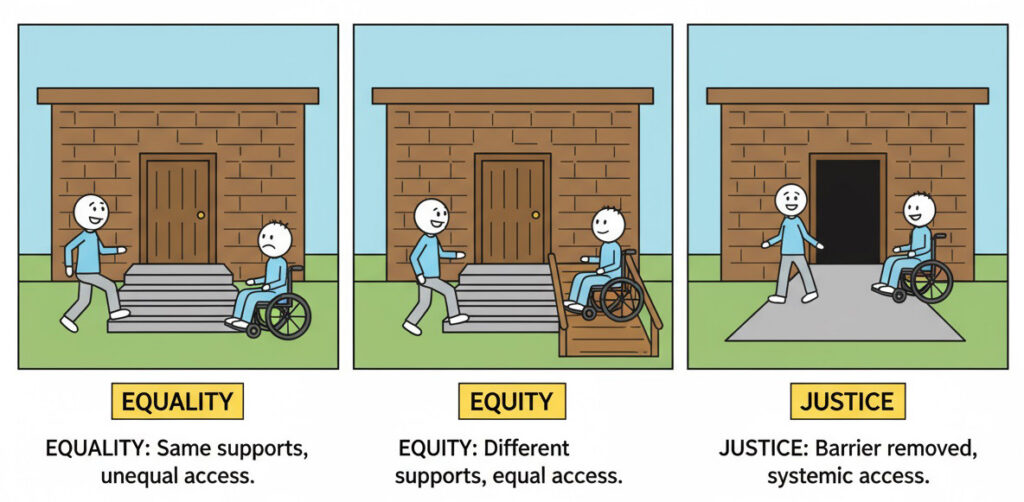
To illustrate the power of this approach, it is worth considering an illustration of the difference between equality, equity, and justice. Working around existing barriers to give everyone access is a major accomplishment and results in equity—something we as a society are far from achieving. But it is not the ideal.
The ideal is not to work around existing barriers, but to remove those barriers altogether, thereby achieving true justice.
Rav Asher Weiss on Ḥeresh: Redefining Speech
A teshuvah (responsum) from Rav Asher Weiss (Israel, 1953-, a leading contemporary posek in Israel and the U.S.) regarding the halakhic status of a ḥeresh (a deaf person who does not speak intelligibly) is a perfect example of this goal. Traditionally, the ḥeresh was categorized alongside the mentally ill and the minor as lacking the mental competence necessary for halakhic obligation. This classification reflected a historical reality: without access to education or communication methods, deaf individuals appeared to lack intellectual capacity.
Over the last few centuries, poskim have found various ways to argue that this status no longer applies, but these were often through various workarounds, and as a result, a number of poskim were only willing to be inclusive for some cases and not for others.
Rav Weiss, in his teshuvah on this topic (Minchat Asher 2:86), breaks new ground in two ways. First, he argues that while the Gemara did not give a different status to an individual deaf person with demonstrated intelligence, that was only because the status of not having sufficient working intelligence still held true for the category as a whole. However, now, when all deaf individuals demonstrate full intellectual capacity, the category as a whole is now false and cannot be maintained. To insist on their exclusion becomes not just unjust, but halakhically absurd. How, asked Rav Weiss, can a person have an hour-long conversation with a deaf person through sign language about a sugya in the Gemara, debating the commentaries of Rashi, Tosafot, and the Rishonim, and then refuse to count him towards a minyan because he is not a bar da’at (person with intellectual capacity)? The category’s continued application contradicts observable reality and undermines halakhah’s credibility.
This is an example not of redefinition, but of reassessing an entire category due to a fundamentally different reality. While profound and thoroughgoing in the case of the ḥeresh, this approach is not easily transferable to other cases of exclusion. That next step comes at the end of Rav Weiss’s teshuvah.
In his teshuvah’s final section, Rav Weiss suggests that fluent sign language communication should be considered a form of speech (dibbur) and a deaf person who can communicate in this way is a “speaking person.” The category of ḥeresh only applied in the Gemara to someone who could not speak intelligibly, which is not true for a person who can speak via sign language. This is different from the case of someone who can “speak via writing,” whom the Gemara considers to not be in the category of a “speaking person.” Communicating via writing is indirect and lacks the dynamic of direct speech between two people. Sign language, on the other hand, is direct, interactive, and expressive communication, and thus constitutes full speech.
If barely intelligible verbal speech qualifies as speech according to many poskim, then how, Rav Weiss implicitly asks, can fully articulate signed communication be excluded merely because it doesn’t use sound waves? What Rav Weiss is asking us to consider is the simple question of whether speech should only be defined from the perspective of those with hearing. For them, speech is about something that is audible. But why should we only define speech from that perspective? For a deaf person, the definition of speech has nothing to do with sound waves. So why shouldn’t halakhah embrace that definition—possibly for everyone, but certainly for those who are deaf and for whom this is their primary form of communication?
The Next Frontier
The redefinition of speech for a deaf person that Rav Asher Weiss presents opens extraordinary possibilities. If sign language constitutes speech, does someone reading Megillat Esther in sign language fulfill the mitzvah for those who understand that language? If signing represents both speech and, for its recipients, hearing, might entire communities conduct their ritual obligations in this medium?
This is a perfect example of a halakhah that can recognize people with disabilities, embrace their realities, and articulate criteria and define categories that reflect those realities.
To return to our case of birkat kohanim. Following this approach, we would ask not whether a person in a wheelchair would fulfil the mitzvah despite the fact that they are not standing, but rather a more fundamental question: what constitutes “standing” for someone in a wheelchair? How would a person in a wheelchair move their body or position themself to show respect to an important personage who had just entered the room? Would they straighten their back and sit at attention? Would they raise their backside off of the seat of the wheelchair? Let’s try to understand what constitutes standing from their perspective, not from ours, and then let’s ask if halakhah would be prepared to recognize this as “standing” for them.
This approach, it should now be obvious, differs fundamentally from case-by-case accommodation. When we redefine categories and acts, we’re not making exceptions—we’re expanding our understanding of what authentic performance looks like. A person using sign language isn’t receiving a lenient ruling about speech requirements; they are speaking. A person in a wheelchair who leans forward respectfully isn’t approximating standing; they are standing in the way available to them.
People are not receiving accommodations that mark them as different or lesser according to this approach. They are rather participating fully in the same mitzvot as everyone else, with definitions that recognize and reflect their reality.
The model also addresses what we might call halakhah’s “ableist infrastructure”—the unexamined assumption that normative practice assumes certain physical and sensory capabilities. By explicitly recognizing alternative modes of performance, halakhah can move from reinforcing ableist assumptions to actively dismantling them.
Practical Applications and Limitations
This approach requires careful application. Not every accommodation can be achieved through redefinition, and not every mitzvah admits of alternative performance modes. The goal is maximum inclusion where halakhically possible, not universal inclusion regardless of halakhic
constraints.
Such questions require consultation with people with disabilities themselves—“nothing about us without us,” as disability advocates insist. Authentic redefinition cannot occur without understanding how people with disabilities experience their own embodiment and religious practice.
Contemporary poskim have begun this work in various areas, but much more development is needed, requiring both deep halakhic scholarship and meaningful engagement with disability communities. This work must be done carefully to be true to halakhah’s rigor and integrity. It means examining our assumptions about normalcy, consulting with people whose experiences differ from our own, and being willing to explore new paths—all while we ensure that we remain true to the halakhic system and its demands.
In doing so, we honor both halakhah’s integrity and its capacity for growth, creating space for all Jews to serve God according to their unique gifts and circumstances and to be full and equal participants in our communal institutions and halakhic life.