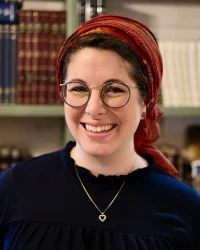

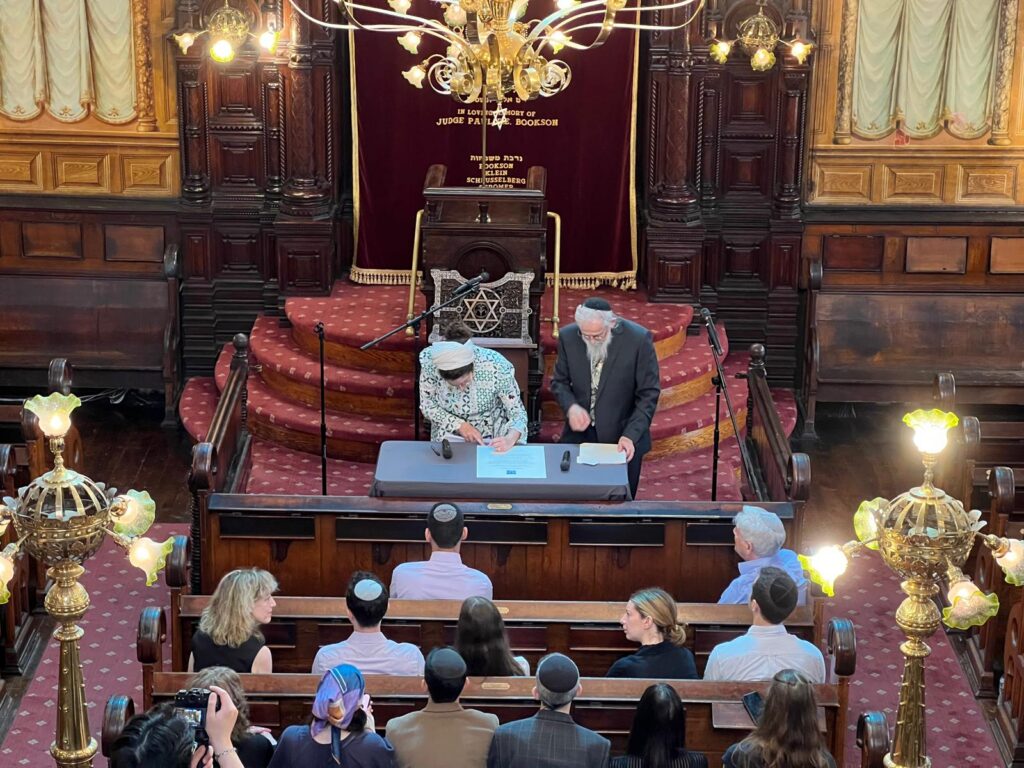
The following is an edited excerpt from Rabbanit Sarna’s remarks at the conference as part of the panel on New Frontiers in Orthodox Communities.
I am the spiritual leader of Kehillat Sha’arei Orah in Lower Merion, Pennsylvania, just outside of Philadelphia. My shul started with a small handful of families who wanted to daven together. It grew slowly until the pandemic, which precipitated great growth in Lower Merion and commensurately our shul.
The leadership of the shul realized that the community needed support with lifecycle events and pastoral issues, so they decided to hire a part-time spiritual leader. But what they did next is really important and unusual. The bylaws of the shul assumed that any spiritual leader hired in the future would be a man. Instead of saying, “Well, it’s in the bylaws; I guess we’re stuck,” they changed the bylaws before even opening a search. When they opened up a search, they opened it up to men and women. At the end of that search, they hired me.
What this story shows is that the creation of Orthodox women rabbis is insufficient without strong lay leaders. Our community has gotten to a miraculous, transformative place that would never have happened without Jofa and Yeshivat Maharat, and the visionary leadership of Rabba Sara Hurwitz and Rabbi Avi Weiss. But the creation of Orthodox women rabbis and community exposure to women rabbis (and financial assistance to shuls to hire them) is not enough. There are three shuls in the United States that I can think of that had women in assistant rabbi positions, but when the senior rabbi position opened up, they did not open the search to women.
Too often a search committee at an Orthodox shul finds that 20 percent of the membership feels strongly that a senior rabbi search should be open to women. But another 20 percent—and often it’s the people who have money or show up to daily minyan—threatens to leave the shul if they hire a woman. And the rest of the membership has no strong feelings either way. So what does the search committee do? They say, “We’ll hire a liberal-minded male rabbi and everyone will be fine.” But where does that leave the women rabbis?
Initially, our sense was that exposure alone would be sufficient: We’ll bring in women as scholars-in-residence, we’ll have women as assistant rabbis, and that will eventually bring about the change. What we’ve learned is that this is not enough. My shul had a lot of exposure to women rabbis. I was already davening there. (We had moved to Philadelphia for my husband’s job.) A colleague had been living in the community while she was studying at Maharat. We’re in Philadelphia, where we even have a model of a shul led by Rabbanit Dasi Fruchter. There couldn’t be more exposure.
Yet when I moved to Philly and asked around about potential positions, the answer was, “Not in Lower Merion, never. Find a different career.” But during my years in Yeshivat Maharat, I had been trained as a community organizer. I used those tools to powermap the community and, over the course of years, in deep partnership with lay leaders, we laid the groundwork for an open hiring process. This involved strategic work and difficult conversations. We asked ourselves who might have reservations and what it would take to bring them along.
As communal lay leaders, you can do this same work. But you need to be addressing this issue ten years before your search ever opens. You likely can already name that influential 20 percent of the shul who will threaten to leave if the shul were to hire a woman. They’re the same people now as they will be in ten years when your rabbi retires. Start talking to them. Put on your community organizing hat and say, “If this is something that matters to me, if I want the search to be open to equally qualified male and female candidates, then I need to start now to work on those 20 percent.” They don’t have to like it; they just need to not leave the shul—or enough of them need to not leave the shul—over the decision to open this hire to women. And that does not happen overnight.
You may want to start by having a conversation about why they really are opposed to having a woman rabbi. You may find it’s not about halakhah, but rather about a fear of the unknown or a fear that the community they love is going to change into something they don’t recognize. You have to show them that having a woman in leadership doesn’t take anything away from them; it adds to the community. And you have to be patient. It’s a slow process of building trust. And eventually you can move them from “no women” to “well, maybe if she’s the right woman.” And that’s as far as you need to go, because then you can open up your search. And once you’ve opened up your search, you can have a fair process.
I want to send each of you home with the thought that you can accomplish this in the same way that the lay leaders in my shul did it. And you can make a change in your community.
Rabbanit Leah Sarna is the Spiritual Leader of Kehillat Sha’arei Orah and Director of Public Education and Media at the International Beit Din. Trained at Migdal Oz, Yale University, and Yeshivat Maharat, she is a sought-after speaker and award-winning educator who has taught Torah in Orthodox synagogues and Jewish communal settings around the world.