
I met Blu Greenberg 25 years ago, but she had shaped my life long before I met her. I had become Orthodox when Jeremy and I married, and my mother-in-law had given me Blu’s How to Run a Traditional Jewish Household. I read it cover to cover. It became my Bible.
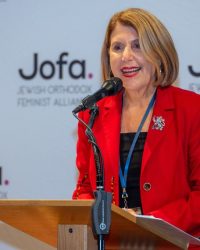
Not long after we met, Blu invited me onto the board of Jofa. “What’s Jofa?” I asked—the Jewish Orthodox Feminist Alliance. And I said, “Wait, Orthodox women can be feminists?” I was excited and terrified at the same time—excited because I had always been a feminist, and terrified because I was secretly relieved that there was no role for me in my shul. I wasn’t particularly learned, and I was still busy figuring out how to run that traditional Jewish household. So how could I do anything else? But I said yes. And that yes began a journey that so many of us in this room have lived. We were there at the beginning. We were rescuing agunot, organizing women’s Megillah readings, creating women’s tefillah groups. We fought to say Kaddish. We advocated for girls to learn Talmud in school. And we proudly watched as Orthodox women became shul presidents. What once felt bold and daring is now simply the world my daughter and granddaughters inhabit.
What began as a group of brave, revolutionary women became a movement. And that movement became a field—a field of Orthodox women’s Torah leadership. A field of women doing things we could only dream of. And the biggest, most unimaginable dream of all: Orthodox women becoming rabbis, leading communities. And now our dreams are no longer dreams. Yeshivat Maharat opened in 2009 as the first Orthodox yeshiva to ordain women. This year Yeshivat Maharat reached a historic milestone—100 ordained women.
In 2020, Jofa launched the Devorah Scholars program in partnership with Jeremy and me and our family foundation, Micah Philanthropies, placing women Torah leaders in Orthodox synagogues. During our time with Devorah Scholars, we placed 11 women in nine shuls. When we saw its impact, we created a full-time placement office in-house at our foundation called The Hub to expand this work. Today there are 52 Orthodox women in leadership roles in Orthodox shuls across North America. They come with semikha, master’s degrees and doctorates in Talmud, Tanakh, Halakhah, and Judaic studies, and training in chaplaincy, having studied at Drisha, GPATS, Nishmat, Maharat, YU, Ohr Torah Stone’s International Halakhic Scholars Program, and other top universities and seminaries. They serve communities in 25 states, Washington, DC, and Canada. There are 22 Yoatzot Halacha serving 26 communities. There are 43 Orthodox women heads of school being supported by Prizmah’s Orthodox Women in Leadership Project—ten in all-girls schools and 33 in co-ed Orthodox schools. We’re seeing a growing number of Orthodox women Torah leaders publishing scholarly books and articles, hosting podcasts, and becoming public intellectuals.
And we recently learned something surprising: There are more shuls, schools, and institutions that want to hire women Torah leaders than there are women available. So we need to build the pipeline for the future. One of the things that we’re doing is starting our new Pava Center for Women’s Torah Scholarship at Yeshiva University. It will be an elite honors undergraduate program designed to encourage young women to consider a career in Torah scholarship and leadership.
So what comes next? Or maybe I should say, what do we need to be doing right now? I believe our moment, our historic moment, is right now. We are living through frightening, polarized times. Not only is our nation divided, but the Jewish community is divided. Antisemitism and anti-Zionism are at an all-time high. Families are so torn apart over Israel that some are no longer speaking to each other. And I believe that you, the women in this room, and others like you, will help heal our fractured world. Why? Because study after study shows that women bring leadership qualities the world desperately needs now. We are collaborative. We are listeners. We are consensus builders. We share power and elevate others. And we have something else.
My dear friend Rabba Sara Hurwitz wrote in her Rosh Hashanah sermon, “What the world needs today is radical kindness—a kindness that does not wait for another person to deserve it.” Radical kindness is a deliberate choice to treat people with dignity, generosity, and patience, especially when it’s hard, inconvenient, or emotionally costly. And I believe with all my heart that Orthodox women leaders embody radical kindness. You bring deep Torah wisdom, collaborative spirit, humility, strength, and a profoundly nurturing approach to leadership. And that more than anything is why I believe the world will heal—because you have stepped forward to lead. And the Jewish world, and the whole world, are better for it.