
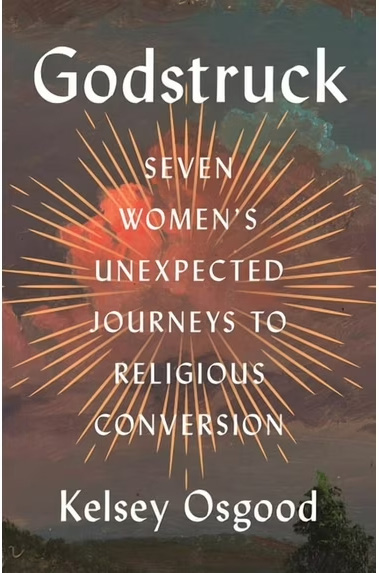
Kelsey Osgood has done a remarkable thing: she’s collected first-person accounts of six women who switched religions—not an easy group of people to find. Osgood, a convert herself (she’s the seventh chapter of the book), weaves in her own insights as she tells their stories, like a knowing friend whispering in your ear as you get to know her subjects.
As a convert to Judaism myself, I read this book greedily, wondering if I would pick up on the same feelings and ideas that motivated me to make my own decision.
Even without the personal stories of conversion, I loved learning a multitude of quirky religious customs from those newly experiencing them: I found out what an Anabaptist is—someone baptized as an adult rather than as a baby, able to truly commit one’s life to the rigors of the religion. Nuns who are not required to shave their heads cut each other’s hair. Mormons wear a type of long underwear beneath their clothes. There’s an order of nuns whose mission is to evangelize through the media (think nuns on TikTok).
In this book (chapter 3), I met Kate, a lapsed-Catholic teen with a Latter Day Saints boyfriend. They broke up before going to college—she on the east coast and he to Brigham Young University. Kate thought the Mass of her upbringing was beyond boring, but during her freshman year of college slogged through the entire Book of Mormon on her own. She began praying in a free-form manner and then, one day, experienced a massive flood of joy in her chest, an explosion of goodness that she perceived as God. All her life she’d been disappointed that she could not connect with a deity that one could not see, or prove, and had felt how nice it would be, at scary moments, to cling to a vision of the afterlife. She was baptized as a Latter Day Saint just as the Covid epidemic broke out—a tough time to embrace a new way of living, but even being isolated did not deter her.
Christina (chapter 5) went from having her First Holy Communion to becoming Amish. She moved from California to Maryland with her mom and sister as a young girl, and the Amish she noticed there reminded her of Little House on the Prairie, which she loved. In high school she began researching the Amish a bit obsessively. She admits being drawn to their simple way of living. Rather than go to college, she gradually began dressing in Amish style and bonded with an Amish couple who ran the local bulk foods store. Learning the theology of Anabaptism and the Pennsylvania Dutch language were her next steps, along with eschewing many modern gadgets. Ten years in, she is unmarried but fosters two young boys and remains happy with her choice.
I found it harder to connect with Angela (chapter 1), a cerebral Chinese woman, a devotee of rationality, who found that the silence of Quakerism spoke to her soul after years of exploring other Christian denominations. Hana (chapter 4) was also difficult to parse; an only child of a single mom, she became an abaya-wearing Muslim, favoring the form of Islam practiced in Saudi Arabia. I thought that perhaps her attraction to Islam was the result of being orphaned as a teen, fitting in with a group of Saudi women and seeking motherly types familiar with family life, more than an attraction to the religion itself.
Kelsey’s own story is based in her feeling perfectly and wholly female, doing an uneasy dance with the girl-boss focus of feminism. She started flirting with Judaism in her early twenties and was fascinated by Orthodoxy, while not believing she could ever live in that manner. Her Jewish boyfriend (now husband) made the journey along with her. Readers hear her take on Orthodox customs relating to women—the dress code, the expectations the community has for women, and motherhood—at great length and with much introspection. She is terribly conflicted about the Eshes Ḥayil (Woman of Valor celebrated on Friday night): “Sure, she gets her own song,” she notes. “But is it worth the exhaustion of keeping her entire house afloat while her husband shmoozes with the elders at the gates? Of course she seems like the perfect woman—she literally does everything.”
Osgood often argues both sides of the same point with dizzying intellectualism. Is being an Orthodox woman the best, or the worst, of both worlds? Then, in the next paragraph, she moves to the issue of covering one’s hair (or not) with hilarious, self-effacing descriptions. As for me, I grew up in the home of a vaguely Christian mother and an adamantly non-religious Jewish father, our Christmas tree the only nod to any religious item in the house. In my twenties I found a Jewish man I wanted to marry and was quite attracted to the idea of having a tribe—a large family and extended community who would have my back, and that I could contribute to. The fascinating ancient traditions and rituals of Orthodox Judaism were also a plus, connecting me to the generations of my dad’s family going back centuries. And Shabbat? Heaven sent! Cannot live without it. This book is a treat to read for its tongue-in-cheek, snarky humor and entertaining, conversational tone, and super-interesting personal stories.