
A central piyyut of the Yamim Noraim, “adam yesodo mei’afar” (“the human being originates from dust”), attempts to capture human frailty by comparing finite human life to “a shattered vessel, a withered grass, a faded flower, a passing shadow, a vanishing cloud, gusting wind, floating dust, and a fleeting dream.”
Ten years ago, on Rosh Hashana 5776, I began to experience complications late in the second trimester of an identical twin pregnancy. Throughout the aseret yemei teshuvah (ten days of repentance), as our personal lives converged eerily with the Jewish calendar, human frailty became reality. When irreversible preterm labor began shortly after Yom Kippur, my husband and I kept returning to that refrain from those solemn days of prayer. “Kaḥalom ya’oof” (“as a fleeting dream”) appears on the shared matzeivah (stone) of our twin girls in the section designated in Jewish cemeteries for burial after stillbirth and neonatal death.
Pregnancy is a state of anticipation, a vision of a future featuring the “expected” child. When pregnancy ends in loss, all that remains is that “fleeting dream”—painfully real, yet no longer within grasp. These experiences are deeply personal and differ based on each individual and couple and the specific features of each pregnancy and gestational stage. Often agonizing and isolating, these experiences bring a sense of isolation that is compounded, for observant Jews, in a feeling of abandonment to a netherworld of halakhah and Jewish thought with only murky halakhic and spiritual guidance.
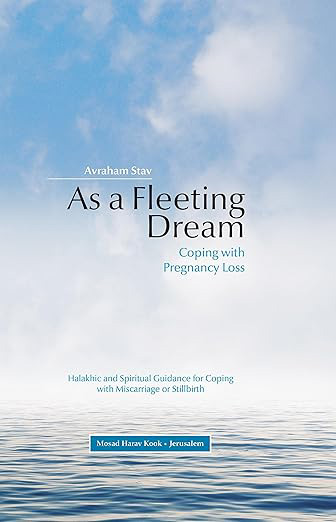
In 2020, my husband and I came across a new Hebrew book by Rabbi Avraham Stav, a compassionate compendium on pregnancy loss, stillbirth, and neonatal death, and were touched by the phrase chosen for the title: “kaḥalom ya’oof.” In 2023, As a Fleeting Dream: Coping with Pregnancy Loss, became widely available in English translation. A significant contribution to recent efforts to fill a lacuna in Jewish and halakhic writings on this painful aspect of life shrouded in secrecy,1 the book is distinguished by the wide range of resources it gathers in a single accessible volume, clearly organized into three sections.
Part I offers halakhic guidance on every aspect of the experience of pregnancy loss. Beginning with burial— typically a feature of later term losses—the book offers mourning practices informed by hilkhot aveilut (the laws of mourning), even as much of pregnancy and neonatal loss falls outside its scope. Philosophical framing for hilkhot aveilut is also offered, making sense of its gaps in the arena of stillbirth and neonatal death without undermining parental grief. Another sensitive topic for those in the immediate aftermath of pregnancy loss relates to the mother’s halakhic status as a niddah and a yoledet. These discussions are supplemented by questions that arise in more specific situations. The author shares his own family’s experience of loss through an abortion that followed a devastating fetal diagnosis, offering halakhic guidance in this sensitive area and reminding the Jewish community that abortions in such cases are experienced quite similarly to spontaneous losses.
Part II, “Faith,” orients readers toward Jewish thought and theology, marshalling a diverse array of Jewish sources to provide solace and discretionary action steps, including prayers, that some may find meaningful. Inter alia, Stav addresses how the fetus is conceptualized in traditional Jewish thought— as a soul, a part of the family, and a part of the Jewish people—validating the reality of the loss felt by many parents, even though it is not enshrined in hilkhot aveilut.
Part III reprints contemporary words of reflection by a variety of leaders within the Orthodox community directly addressing pregnancy loss and stillbirth—from personal experience, or written as consolation to specific individuals in the throes of such loss.
Anyone seeking Jewish guidance after pregnancy loss can find something meaningful and grounding in this compassionate, wise, informative book. Any attempt to gather a semi-comprehensive set of resources for such a difficult and highly personal life experience will undoubtedly also include material that does not land well for everyone. Consider the “Segulot” offered in Part II, all grounded in traditional sources and framed with sensitivity. Such practices border, perhaps unwittingly, on the suggestion that parents, especially mothers, can have a measure of spiritual agency over future losses—a notion that can be quite painful, even harmful, for some. Others have understood these traditional practices differently, finding hope and empowerment in them. While the experience of pregnancy loss and neonatal death is universal, the same treacherous terrain must be navigated by human beings with different backgrounds, dispositions, and understandings of how the Divine will operates in our frail and finite human world. Survival requires both self-protection and compassion for others on the same path.
As a Fleeting Dream brings pregnancy loss into normative halakhic and Jewish communal discourse, without shying away from highly sensitive subtopics. Prefaced with haskamot from widely recognized rabbinic authorities, the book is clearly geared toward mainstream Orthodox audiences. Nevertheless, as a font of diverse resources of Jewish thought, the book has significance beyond discussions of practical halakhah, and its utility transcends the bounds of the community from which it originates and at which it aims. Required reading for rabbis, the book is recommended for those experiencing pregnancy loss (when ready), and for friends and family seeking Jewishly infused language, context, and resources for understanding such experiences and providing emotional support.