
Israel’s High Court of Justice recently issued what would have been a bombshell had the news cycle not been rightfully consumed by the war in Gaza: A unanimous court ruled that women are entitled to sit for state rabbinic exams. The ruling does not mean that state-recognized women rabbis are on the horizon, but it does mean that women will be able to access the test for other employment purposes. It was thus read as a significant, if imperfect, step towards gender equality.
Like many policy wins targeting religiously inspired state-sanctioned gender inequality, women from Israel’s dati sector—Religious Zionist in Israel, Modern Orthodox elsewhere—are responsible for this triumph. Plaintiffs were highly trained women Torah scholars, beneficiaries of one of the Orthodox feminist movement’s great achievements: women’s access to Jewish literacy. One plaintiff, Shlomit Piamenta, executive director of the egalitarian Beit Hillel rabbinic organization, explained that she joined the lawsuit because she wanted her “daughters and granddaughters, God willing, to study in batei midrash [houses of Torah study] that are on a high level, that have high aspirations— and that must go hand in hand with recognition.”
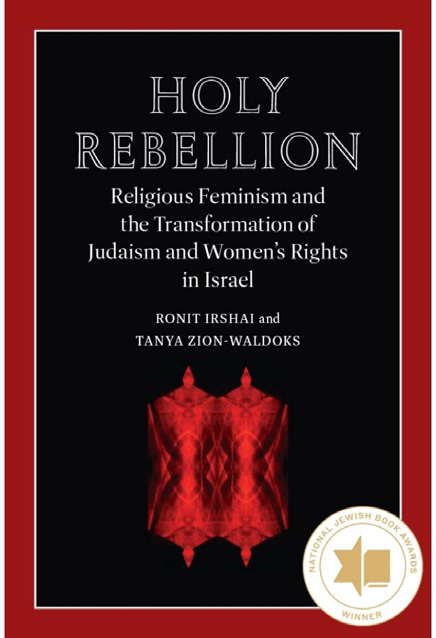
Such Orthodox changemakers and the intra-Jewish culture war about women in Jewish life are the subject of Dr. Ronit Irshai and Dr. Tanya Zion-Waldoks’s awardwinning book about feminist change in a conservative religious context. The book is an intellectual tour de force, marching through Jewish texts, ancient and modern, Supreme Court cases, and decades of social science research. The breadth is the product of a collaboration between a Jewish Studies scholar and a social scientist, both hailing from the milieu they study.
Empirically, the book provides a first comprehensive analysis of the movement’s achievements—and backlashes to it—across arenas of Orthodox feminist activism which typically receive individual treatment: Torah study and Jewish leadership, synagogue rituals, family law reforms, and sexual and modesty politics. Chapter 2 discusses the arenas for renewing Orthodoxy from within, while Chapter 3 unpacks the backlash that religious changemakers are up against.
Conceptually, the book uses the movement as a starting point to think about universal questions confronting feminist movements across conservative religious traditions: multiculturalism, the relationship between law and culture, the balance between tradition and change, illiberalism, and the relationship with the state.
Critics have argued that religious feminist movements fail feminist litmus tests: they are insufficiently radical, introspective about religious patriarchy, or intersectional. Irshai and Zion-Waldoks push back against such critiques. Their theory of religious feminism hinges on a balance between the stabilizing, or tempering, effects of the law, and cultural creativity, innovation, and diversity. (Chapter 4 tests this theory.) Cautious religious feminism here emerges as a safeguard for activists and their communities against both stagnation and rootlessness.
Moreover, across arenas, Orthodox feminists deploy social change as a means to a fulfilling Jewish life—on their terms. They seek a deeper connection to God, to broaden their involvement in their religious communities, and to achieve “a more just, inclusive, and relevant Judaism” (p. ix). Though radical change may not be their intent, as these changemakers reinterpret their tradition, the result is sometimes dramatic transformations in religious culture, law, and society. What makes them inadvertent changemakers who practice a tempered feminism—and their rebellion holy—is that their actions, strategies, network, knowledge, and visions of society can all be traced to the same source: the Jewish tradition.
The stakes are high when Orthodox women challenge and change the rules of marriage, family life, and sexual culture; when they question Judaism’s essentialism and patriarchy; when they demand to be heard in synagogue and courts and to occupy civil service positions. While technically a demographic and cultural minority, given religion and state relations in Israel and its political power structures, religious Zionists have an outsized impact on national law, politics, and culture. Orthodox feminists’ challenges to intra-sectorial gender arrangements may therefore push national politics writ large “in the spirit of egalitarian liberal values” (p. 34). This is a cause for optimism.
On the flip side, however, the national context raises other questions. Does there come a point when cautiously working from within a religious tradition can no longer be labeled as feminist, egalitarian, or liberal? There is another litmus test that we might apply—that of a feminist ethic of care that could fuel anti-war activism: emphasis on relationships, interdependence, empathy, and responsiveness to the needs of all involved parties, including Palestinians. Thus far, Orthodox feminists have not led this charge. Is it possible that the rationales, strategies, and sources that drove their holy rebellion in other arenas serve as a foundation for doing so?