
One moment can change everything. For my husband Eitan, that moment came eight years ago with a massive stroke that stole his words but not his voice. What happens when a voice goes silent—not just in a home, but in a community? For us, this question became the beginning of Koach Eitan.
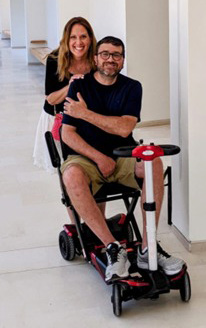
Eight years ago, my husband Eitan’s life—and ours as a family—changed forever. At just 42, he suffered a massive stroke that left him with hemiparesis on his right side (complete loss of use of his right arm and weakness in his right leg), complete memory loss from before the stroke, chronic pain, neurological fatigue, and aphasia. In an instant, the man who had always thrived on words—as a beloved father and husband, business owner, Magen David Adom paramedic, CrossFit coach, and Torah scholar—lost the ability to remember, speak, read, and write. The physical recovery was grueling—having to learn everything from scratch like swallowing, walking, eating, standing, and more. This included speech therapy, physical therapy, and occupational therapy. To date, Eitan is still working hard in different therapies, and there is improvement every single day.
Understanding Brain Injury and Aphasia
Brain injury is one of the least understood and least spoken-about conditions. Not because it’s rare—but because people don’t know how to talk about it. It’s an invisible injury, yet it can affect every part of life—speech and understanding, memory, emotion, personality—and often physical abilities too. Walking, balance, movement, vision, swallowing—even the simplest things can become battles to relearn. And when people don’t understand, families feel alone.
Aphasia is a language impairment that affects a person’s ability to communicate. It’s often caused by stroke or brain injury and impacts speaking, understanding, reading, and writing—but it doesn’t affect intelligence. Think of it this way: the thoughts and knowledge are all there, but the pathways to express them are damaged. Someone with aphasia might know exactly what they want to say but cannot find the words, or they might understand perfectly but struggle to respond. It’s like having a word constantly on the tip of your tongue, except it affects every aspect of communication.
For Eitan, and for us as a family, this meant that every conversation, every daily activity, every interaction in shul, every simple exchange with friends became a reminder of how much had been taken from us. Imagine being trapped inside yourself, unable to share your thoughts or feelings, despite your mind being as sharp as ever.
Early on, I searched desperately for support. Rehabilitation centers focused on the immediate medical needs, but what came after? Where was the guidance for rebuilding identity, dignity, and connection—for survivors and their families? I found one friend who had gone through something similar and she became my lifeline, but most often we found ourselves navigating this journey alone. That sense of isolation—of simply not knowing what to do or how to do it—is what ultimately led us to found Koach Eitan.
Our Mission
Koach Eitan is a nonprofit inspired by Eitan’s journey and by the many others like him. We support people living with the effects of brain injury, stroke, and aphasia, and we stand with the families who carry so much during the recovery journey—in Israel and around the world. Our mission is to restore hope, connection, dignity, and belonging—to ensure that no survivor, family member, or caregiver feels alone.
The Koach Eitan Lifeline
One of the projects closest to my heart is the Koach Eitan Lifeline. We realized that one of the hardest moments for families comes at the time of discharge from the hospital, when formal therapies taper off and you suddenly face “the rest of your life” with very little guidance. Koach Eitan Lifeline steps into that gap. In Israel, we work with social workers and speech therapists at rehabilitation centers to provide patients and families with practical resources, emotional support, and connection to a network of peers who truly understand. Outside of Israel, our volunteers connect with patients and their families to provide similar resources and support. We hold different events throughout the year and also deliver holiday packages to remind families that they are not alone as they navigate this new reality.
Judaism and Inclusion
Another powerful initiative involves our work within Jewish communities. So much of Judaism revolves around language, which makes inclusion particularly challenging for those with aphasia. This year marks our fourth annual World Aphasia Shabbat. Every year, on Parashat Shemot, we mark this Shabbat in synagogues and communities around the world.
Why Shemot? Because when Moshe first encounters God at the burning bush, he says, “Lo ishdevarim anokhi” (“I am not a man of words”). Moshe, our greatest leader, identified himself as someone with a speech challenge. For us, this becomes a powerful reminder of all those whose voices are challenged by aphasia and the effects of brain injury. Since many people don’t know what aphasia is, this Shabbat opens space for communities to learn about aphasia, communication, and inclusion. Last year, Eitan himself sat before a packed room, bravely answering audience questions with honesty, humor, and vulnerability. It was raw, powerful, and unforgettable.
These moments are what Koach Eitan is about— giving back dignity, restoring belonging, and reminding people that their lives are still filled with meaning and contribution.
We saw the same impact during Pesach, when we launched an Accessible Haggadah designed for people with aphasia and other learning challenges. With large font, concise commentary, and instructional icons, it allowed so many people— beyond just those with aphasia and language impairments—to take an active role in the seder again. One woman told me, through tears, “For the first time in years, my husband could lead part of our seder.”
The Broader Impact
We had to learn how to live by accepting all that came our way, and we now help others by sharing what we’ve learned and providing education, awareness, and innovative tools like our Haggadah and blessing cards with icons that have helped Eitan participate in activities that were once sources of frustration.
There are so many people in Israel living with the long-term effects of stroke and brain injury. In this war alone, over 360 soldiers have suffered brain injuries. Many are young, in the prime of their lives. Too often, they and their families retreat into isolation. Again and again, I hear the same words from wives, mothers, and family members who reach out: “No one gets it. I feel alone. I have no one to talk to who can understand.” Koach Eitan is working to change that. In the coming year, we plan to expand the Koach Eitan Lifeline to rehabilitation centers across Israel, pair our volunteers with more families and survivors for ongoing support, launch our new ḥavruta and zoom parsha shiur initiative, and develop more tools that will make Jewish life—from shul to shiur to family table—accessible to all. Our dream is bold but simple: that every person, regardless of their ability to speak, can know the joy of belonging and the dignity of being heard.
The Meaning Behind Our Name
The name Koach Eitan means “Eitan’s Strength.” It honors not only my husband’s resilience but also the hidden strength in every survivor and caregiver. It also carries within it koaḥ (strength) and tikvah (hope). For me, and for us as a community, this work is rooted deeply in Torah. Every person is created b’tzelem Elokim—in God’s image. Inclusion is not just kindness; it is justice. Healing does not end in the hospital. It must happen in our communities, in our synagogues, in our schools, and in our homes.
Looking Forward
What began as our family’s struggle has grown into something much larger than us. Koach Eitan is becoming a lifeline for many others—supporting survivors, holding families, and building communities where everyone has a place. My dream is that no one living with brain injury or aphasia should ever feel alone, and that every person—whatever their abilities—can live with dignity, purpose, and connection.
As readers who understand the power of community and the urgency of inclusion, I invite you to partner with us. You can help by spreading awareness about aphasia, by bringing our initiatives like World Aphasia Shabbat, our Accessible Haggadah, our blessing cards with icons, and more to your own synagogues and schools. Together, we can build a Jewish world where every voice can be heard.
Whether you’re interested in volunteering, bringing our programs to your community, or supporting our mission through partnerships or funding, there’s a place for you in this work. Every act of inclusion, every moment of understanding, every effort to make Jewish life more accessible creates ripples that reach far beyond what we can see.