
As I consider the magnitude of this moment—the 25th anniversary of Jofa—I feel an overwhelming sense of gratitude toward those who have fearlessly blazed Jofa’s trail, so that we may all reap the benefits.
I’d like to take this opportunity to reflect on the past 25 years, from our humble beginnings around a founder’s kitchen table, when a few incredibly strong and passionate Orthodox feminists articulated a vision of what it means to be an Orthodox feminist.
Our visionary and courageous founder, Blu Greenberg, fearlessly laid the groundwork for so many aspects of that original shared vision to be realized. Innovations that once seemed unheard of and impossible have become the norm. Life-cycle rituals have become more inclusive, with young couples finding opportunities for both men and women to participate in their wedding ceremonies and new parents creating meaningful simḥat bat ceremonies for their daughters. Girls and women have expanded opportunities to learn Torah from beginner to advanced levels and to participate in various parts of tefillah.
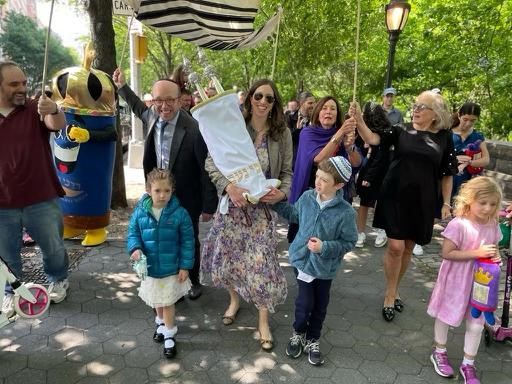
Jofa President Mindy Feldman Hecht leads
a procession dedicating a Sefer Torah at
Darkhei Noam in New York.
I am the beneficiary of many of these changes, having learned Gemara alongside boys in high school and then spending a year of intensive study at Migdal Oz in Israel after high school. Today, thousands of women, many of whom had very little formal Talmud education, learn daf yomi thanks to the abundance of learning tools and platforms, as well as the explosion of accessible learning opportunities around the world. Every year, more people organize women-led and partnership minyan megillah readings for Purim, as well as Pesaḥ, Shavuot, Sukkot, and Tisha B’Av, with the help of Jofa’s leyning apps. More and more shuls across North America have come to see the value and benefits that having female spiritual, halakhic, educational, and lay leadership can bring to a congregation through the Devorah Scholars program. We must continue to cultivate future leaders who are compassionate, learned, and dedicated to serving those on both sides of the mehịtzah.
Recently, my family and I had the privilege of spearheading an effort to dedicate a new Sefer Torah at our synagogue, Darkhei Noam, in honor of its 20th anniversary. This milestone moment gave me pause to reflect on how many girls and women have had their first aliyah at Darkhei Noam; how many girls and women have had the chance to dance with the Torah for the first time on Simḥat Torah; how many young girls have joined their male counterparts to lead Adon Olam at the end of davening on a typical Shabbat without thinking twice about it; and how many more girls and women will be able to carry, dance, read, and raise up this newly dedicated Torah.
Jofa’s commitment is to normalize the undeniable value of such inclusiveness and continue to create more vibrant and equitable communities within the framework of halakhah. Let us strive and work together to build communities that are welcoming to all—for we all yearn to feel heard, included, valued—and connected.